




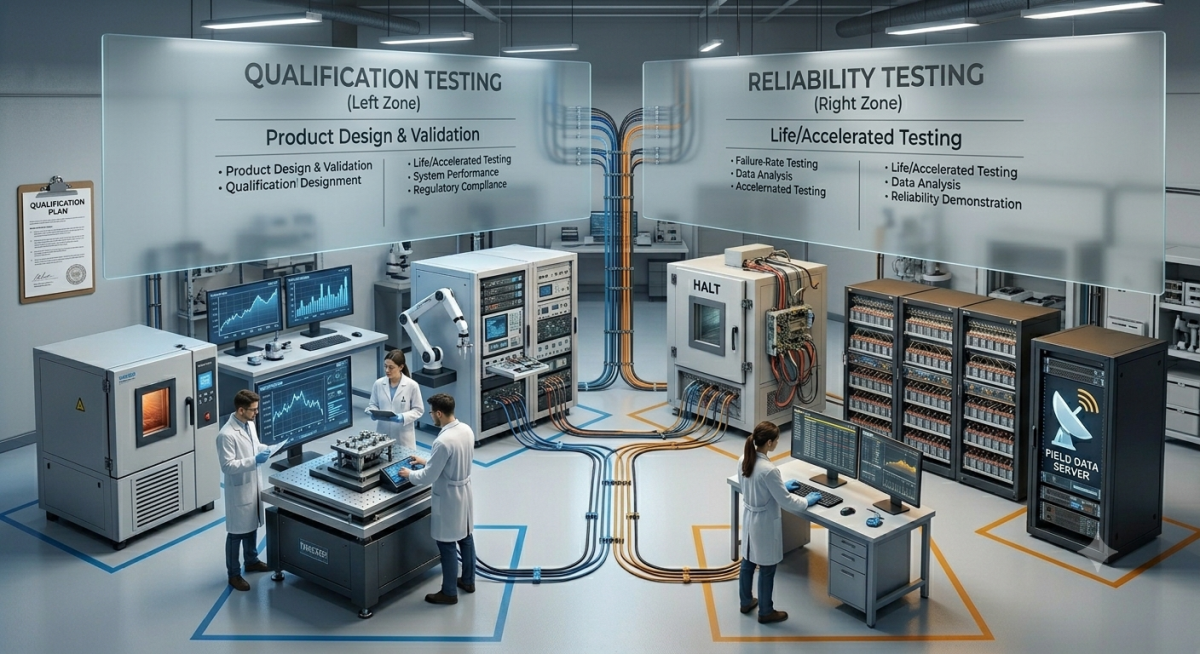
Testing is an essential part of product development, but not all tests serve the same purpose. Two terms that are often used interchangeably are qualification testing and reliability testing. While both play important roles in ensuring product performance, they answer very different questions.
At its core, qualification testing asks: Can the product meet a defined requirement?
Reliability testing asks: How long will the product continue to perform under real-world conditions?
Understanding this distinction is important because a product that passes qualification testing is not necessarily proven to be reliable over its intended lifespan.
Qualification testing is typically performed to verify that a product meets specific standards, specifications, or customer requirements. These tests are often conducted under predefined conditions and acceptance criteria. The outcome is usually a pass or fail decision.
Examples of qualification testing include verifying that a product can withstand a certain temperature range, meet an IP rating, or comply with industry standards. Once the product successfully meets these requirements, it is considered qualified for its intended application.
Reliability testing takes a different approach. Instead of focusing on whether a product meets a requirement at a single point in time, reliability testing evaluates how performance changes over time and under repeated stress.
Engineers use reliability testing to understand how products age, degrade, and eventually fail. Environmental conditions such as thermal cycling, humidity, vibration, and corrosion are often accelerated in laboratory environments to simulate years of use within a shorter timeframe.
Qualification Testing vs Reliability Testing
| Qualification Testing | Reliability Testing |
|---|---|
| Verifies compliance with specifications | Evaluates long-term performance |
| Focuses on pass or fail criteria | Focuses on degradation and lifespan |
| Conducted under defined test conditions | Often uses accelerated stress conditions |
| Answers "Can it work?" | Answers "How long will it work?" |
| Supports certification and validation | Supports durability and risk reduction |
Both types of testing are important and complement one another. Qualification testing ensures that products meet minimum requirements before deployment. Reliability testing provides confidence that products will continue to perform throughout their service life.
A product may successfully pass qualification testing yet still experience reliability issues after years of field use. This often occurs because real-world environments introduce combinations of stress that are difficult to capture in a simple pass-or-fail test.
Reliability testing helps bridge this gap by exposing products to conditions that mimic long-term usage. Engineers can identify weak points, study failure mechanisms, and improve designs before products reach customers.
From a business perspective, both forms of testing contribute to product quality, but in different ways. Qualification testing helps ensure compliance and market readiness. Reliability testing helps reduce warranty claims, maintenance costs, and unexpected failures in the field.
In the end, qualification testing and reliability testing are not competing approaches. They are complementary tools that answer different questions about product performance. One confirms that a product meets requirements today. The other helps ensure that it continues to meet those requirements tomorrow.



