




Testing is often seen as an objective process. A product is placed under specific conditions, measurements are taken, and conclusions are drawn. However, the accuracy and usefulness of those conclusions depend heavily on one critical factor: the test conditions themselves.
A test result is only as meaningful as the conditions under which it was obtained.
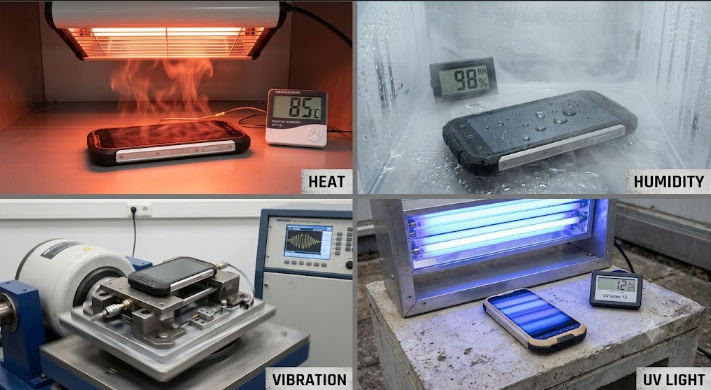
In real-world environments, products are exposed to a wide range of stresses, including temperature fluctuations, humidity, vibration, ultraviolet radiation, and mechanical loading. If laboratory conditions do not accurately reflect these environments, test results may fail to predict actual product performance.
Consider temperature testing as an example. A product evaluated at a constant temperature may perform well, but real-world conditions are rarely constant. Daily temperature cycles cause repeated expansion and contraction of materials, leading to fatigue over time. A test that only considers steady-state conditions may overlook important failure mechanisms.
Humidity presents a similar challenge. Low humidity and high humidity can produce very different outcomes, even when all other conditions remain unchanged. In some cases, temperature and humidity interact to accelerate corrosion, moisture ingress, or material degradation far more than either factor alone.
The rate at which stress is applied also matters. Rapid temperature changes may create thermal shock, while slower changes may simulate thermal cycling. Although both involve temperature variation, they can produce entirely different failure modes and test outcomes.
Factors That Influence Test Results
-
Temperature level and rate of change
-
Humidity level and exposure duration
-
Vibration intensity and frequency
-
Ultraviolet exposure and radiation intensity
-
Number of cycles and test duration
-
Interaction between multiple stress factors
Even small changes in test conditions can significantly alter results. Two products tested under slightly different parameters may exhibit different behaviours, making comparisons difficult. This is why repeatability and well-defined test procedures are essential in engineering.
Environmental testing is not simply about applying stress. It is about applying the right stress in a controlled and representative manner. Engineers must carefully design test profiles that reflect expected operating conditions while also accelerating potential failure mechanisms.
This balance can be challenging. A test that is too mild may fail to reveal weaknesses. A test that is unrealistically severe may produce failure modes that would never occur in actual use. Effective testing requires an understanding of both the product and the environment it will encounter.
Standards and industry guidelines help provide consistency, but they cannot account for every application. Products used in tropical climates, coastal environments, or high-vibration settings may require customized test conditions beyond standard requirements.
From a reliability perspective, test results should always be interpreted within the context of how the test was performed. A passing result does not necessarily guarantee field performance, just as a failure does not always indicate poor design. Understanding the conditions behind the data is just as important as the data itself.
In the end, testing is not only about measuring performance. It is about creating meaningful conditions that reveal how products behave in the real world. By carefully selecting and controlling test conditions, engineers can obtain results that are more accurate, more relevant, and ultimately more valuable.



