


Core Strength vs Core Stability for Lower Back Pain
Core strength and core stability are not the same: core strength helps you produce force, while core stability helps you control and protect the spine during movement. At One Spine Chiropractic & Physiotherapy, we provide chiropractic care, physiotherapy rehabilitation, posture correction, and core stability training to help improve lower back pain and long-term spinal support.
Many people with lower back pain focus on building stronger abs, but strength alone may not solve the problem. In this guide, we explain the difference between core strength and core stability, why stability is often more important for lower back pain, and how proper assessment, movement retraining, and personalized rehabilitation help restore better spinal control.
What Is the Difference Between Core Strength and Core Stability?
Core strength is the ability of the core muscles to generate force, while core stability is the ability to control the spine and pelvis during movement. For lower back pain, stability is often more important because the spine needs coordinated support, not just stronger muscles.
Quick Comparison: Core Strength vs Core Stability
| Area | Core Strength | Core Stability |
|---|---|---|
| Main role | Produces force and power | Controls spinal movement |
| Focus | Muscle strength and endurance | Spine control and coordination |
| Key muscles | Abdominals, obliques, glutes, lower back muscles | Transverse abdominis, multifidus, pelvic floor, diaphragm |
| Common exercises | Sit-ups, deadlifts, resisted planks, Russian twists | Dead bugs, bird dogs, pelvic tilts, controlled planks |
| Best for | Lifting, sports, power, endurance | Lower back protection, posture, balance, movement control |
| Back pain relevance | Helpful after control improves | Often essential for recurring lower back pain |
Key takeaway: A strong core helps you move with power, but a stable core helps your spine stay supported during daily movement.
What Is Core Strength?
Core strength refers to the ability of the muscles around the trunk, hips, and lower back to produce force and support physical activity. It helps with lifting, exercise, sports performance, and general movement endurance.
Core strength involves muscles such as:
- Abdominals
- Obliques
- Lower back muscles
- Glutes
- Hip-supporting muscles
Examples of Core Strength Exercises
Common core strength exercises include:
- Sit-ups
- Deadlifts
- Russian twists
- Planks with resistance
- Weighted carries
- Glute bridges with resistance
These exercises can be useful when performed correctly and at the right stage of recovery. However, for people with lower back pain, strengthening too early or too aggressively may increase strain if the spine is not stable enough.
Purpose of Core Strength
Core strength helps:
- Improve power and endurance
- Support lifting and physical activity
- Improve athletic performance
- Build stronger trunk and hip muscles
- Reduce fatigue during movement
A person can still have a “strong” core and experience lower back pain if the muscles are not activating, coordinating, or stabilizing the spine properly.
What Is Core Stability?
Core stability refers to the ability to control and stabilize the spine during movement, posture changes, and daily activities. It is less about how much force you can produce and more about how well your body controls pressure, alignment, and movement.
Core stability depends on deeper stabilizing muscles such as:
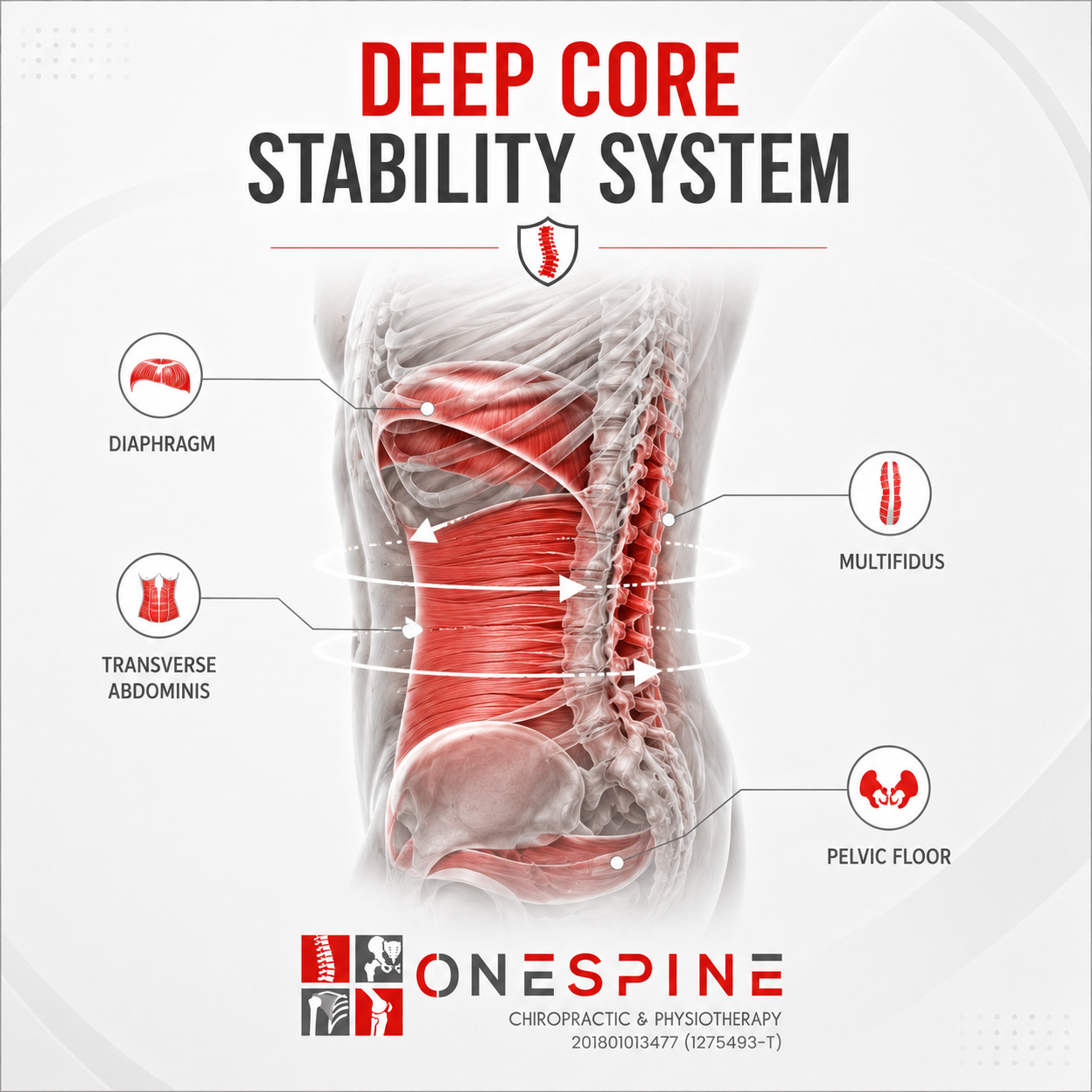
- Transverse abdominis
- Multifidus
- Pelvic floor muscles
- Diaphragm
- Deep hip stabilizers
Purpose of Core Stability
Core stability helps:
- Maintain spinal alignment
- Prevent excessive spinal movement
- Reduce stress on discs and joints
- Improve posture and balance
- Support safer bending, lifting, and walking
- Improve movement coordination
Important note: Core stability is not about holding the body stiff. It is about controlled movement, proper timing, breathing control, and balanced support around the spine.
Poor core stability often causes the body to compensate. This may lead to lower back pain, muscle tightness, poor posture, recurrent injuries, and movement-related discomfort.
Why Core Stability Matters More for Lower Back Pain
For many lower back pain sufferers, the issue is not simply lack of strength; it is lack of control. When the deep stabilizing muscles do not activate properly, the lower back may absorb more pressure during sitting, bending, lifting, walking, twisting, or exercise.
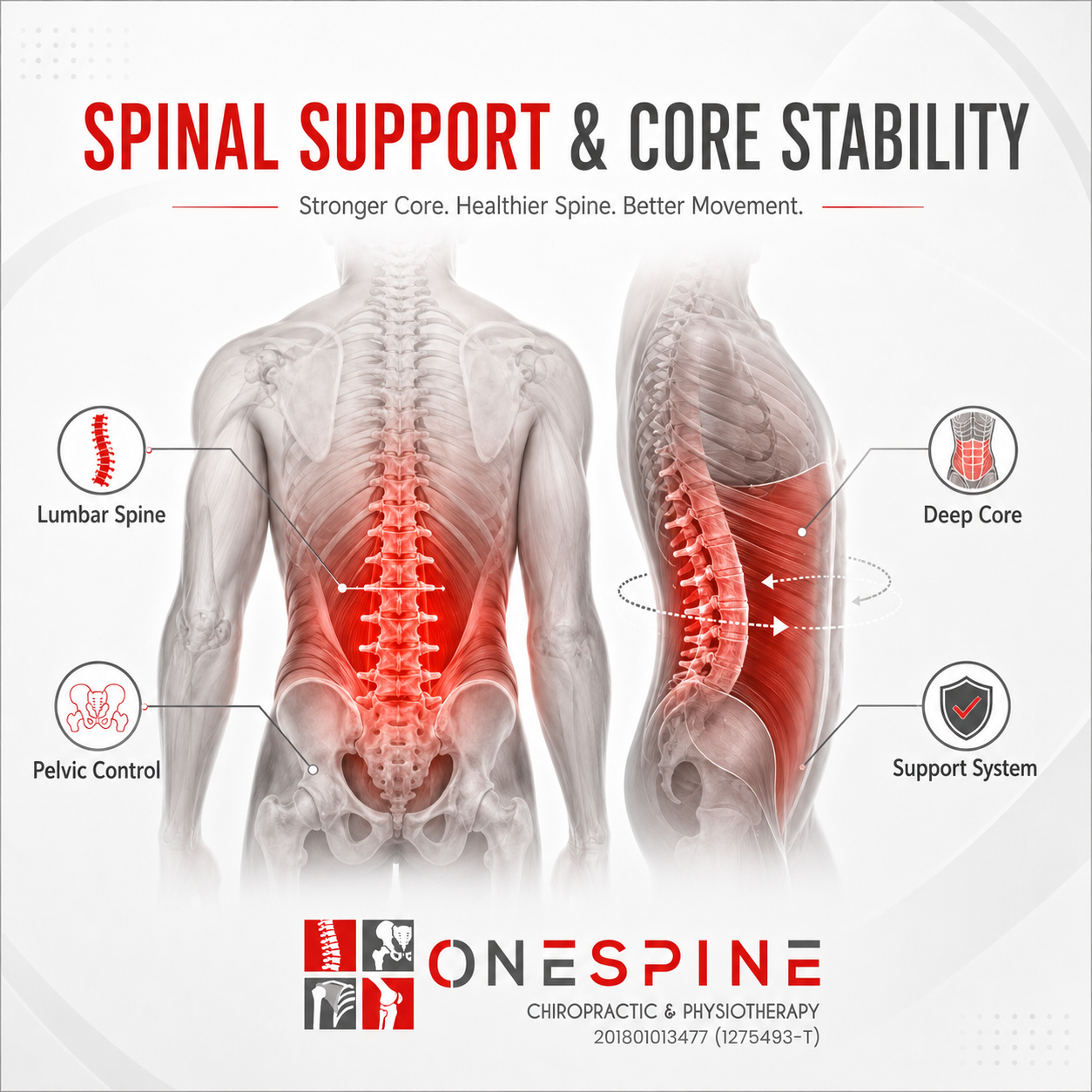
When core stability is poor:
- Larger muscles overwork
- The spine becomes less supported
- Pressure increases on discs and joints
- Movement becomes inefficient
- The hips and lower back may compensate
- Pain may return after rest or stretching
This can contribute to:
- Chronic lower back pain
- Sciatica-like symptoms
- Slipped disc irritation
- Muscle spasms
- Postural imbalance
- Recurrent strain after exercise
Real-World Signs of Poor Core Stability
You may have poor core stability if you notice:
- Lower back pain after sitting
- Pain during bending or lifting
- Tight hips or glutes
- Difficulty keeping posture upright
- Shaking during simple core exercises
- Back discomfort during planks
- Pain that keeps returning after short-term relief
- One-sided lower back tightness
- Poor balance during single-leg movements
Someone may perform heavy gym exercises well but still struggle to control their spine during long sitting, twisting, reaching, carrying groceries, getting out of a car, or bending to pick something up. This happens because daily movement requires timing, posture control, and coordination, not only raw strength.
Quick summary: Core stability helps the body control the spine. When control is poor, the body often relies on tightness, stiffness, or compensation instead of balanced muscle coordination.
Why Strength Alone May Not Fix Lower Back Pain
Strength alone may not fix lower back pain because stronger muscles do not automatically mean better spinal control. If the deep stabilizing muscles are not activating at the right time, the lower back may still become overloaded.
For example, someone may be able to deadlift, squat, or hold a plank but still feel pain when standing from a chair, sitting at a desk, reaching into a low cabinet, or rotating to check a blind spot while driving. These movements require the spine, pelvis, hips, and core to coordinate smoothly.
Strength Without Stability May Lead To
- Overactive lower back muscles
- Poor lifting mechanics
- Excessive spinal arching
- Hip tightness
- Repeated muscle spasms
- Pain during certain movements
- Reduced confidence with exercise
This is why our team looks beyond simple strength testing. We assess how the spine, pelvis, hips, breathing, and core work together during real movement.
How Posture, Breathing, and Hip Mechanics Affect Core Stability
Core stability is closely linked to posture, breathing, pelvic position, and hip control. If one of these areas is not working well, the lower back may compensate even when the core muscles are strong.
Posture and Spinal Alignment
Poor posture can place the spine in a position where the deep core muscles cannot activate efficiently. Long sitting, slouching, forward head posture, and excessive lower back arching may all increase stress on the lumbar spine.
Breathing and Core Control
The diaphragm works together with the deep core and pelvic floor to help regulate pressure around the spine. When breathing is shallow or chest-dominant, the body may struggle to create proper trunk support during movement.
This is why some rehabilitation exercises include slow breathing, bracing control, and ribcage positioning before progressing to harder core exercises.
Hip and Glute Function
The hips and glutes help support the pelvis during walking, squatting, climbing stairs, and lifting. If the hips are stiff or the glutes are not coordinating well, the lower back may take on extra work.
Common examples include lower back tightness during squats, back strain after long walks, or pain when standing on one leg to wear shoes.
How Our Team Assesses Core Stability and Lower Back Pain
Our team assesses core stability by looking at posture, spinal alignment, pelvic control, muscle activation, breathing patterns, and functional movement. The goal is to identify whether lower back pain is caused by weakness, instability, movement dysfunction, posture strain, nerve irritation, or compensation.
At One Spine Chiropractic & Physiotherapy, we do not treat lower back pain as only a muscle pain issue. We look at how the body moves as a connected system.
1. Posture and Movement Assessment
Our assessment may include checking:
- Spinal alignment
- Pelvic positioning
- Core activation patterns
- Muscle imbalances
- Hip mobility
- Functional movement
- Nerve irritation
- Posture habits
- Breathing control
- Movement coordination
This helps us understand whether the pain is linked more to instability, weakness, compensation patterns, or joint restriction.
How One Spine Chiropractic & Physiotherapy Helps
Our team helps with core strength and core stability for lower back pain through integrated chiropractic care, physiotherapy rehabilitation, posture correction, and personalized movement retraining. We focus on restoring spinal support and long-term function, not just reducing symptoms temporarily.
2. Chiropractic Adjustments
Chiropractic adjustments may help improve:
- Joint mobility
- Spinal alignment
- Mechanical movement
- Nerve communication
- Lower back stiffness
- Movement efficiency
When the spine moves better, stabilizing muscles may work more effectively. Better joint mobility can also reduce unnecessary stress on overworked muscles.
3. Core Stability Rehabilitation
Core stability rehabilitation focuses on retraining the body to stabilize the spine properly before progressing to heavy strengthening exercises. This is important because some lower back pain cases may worsen when people strengthen aggressively without first improving control.
Our physiotherapy exercises may focus on:
- Deep core activation
- Breathing control
- Pelvic stability
- Spine control during movement
- Functional rehabilitation
- Posture correction
- Hip and glute coordination
Examples may include:
- Dead bug exercises
- Bird dog movements
- Pelvic tilts
- Controlled plank variations
- Breathing-based core activation
- Slow functional movement drills
Rehabilitation focus: We usually want the body to learn control first, then strength. Stability creates the foundation for safer strengthening.
4. Strength Progression Programs
Once stability improves, treatment may progress into strengthening and endurance work. This helps create a more balanced and resilient spine support system.
Strength progression may include:
- Core strengthening
- Glute strengthening
- Functional movement training
- Mobility and endurance work
- Controlled lifting patterns
- Return-to-exercise planning
- Post-injury strengthening
Progression is important because the body needs both control and strength. Stability protects the spine, while strength helps the body handle greater physical demand.
5. Pain Relief and Muscle Recovery Therapies
When poor core stability causes compensation, certain muscles may become tight, painful, or overworked. Muscle recovery therapies may help reduce tension while rehabilitation restores better control.
Depending on the condition, our team may use:
- Dry needling
- Shockwave therapy
- Soft tissue therapy
- Stretching and mobility work
- Recovery-focused modalities
These therapies aim to reduce muscle overload, trigger points, stiffness, and discomfort. They are most effective when combined with posture correction and active rehabilitation.
What Makes Our Approach Different?
Our approach is different because we focus on the root cause of lower back pain, not only temporary pain relief. We assess whether the problem is related to spinal alignment, poor core stability, weak muscles, posture strain, movement dysfunction, or compensation patterns.
1. Root Cause Focus
We look at:
- Why the lower back became painful
- Which muscles are compensating
- Whether the issue is stability, strength, or alignment
- How posture and movement habits affect symptoms
- Whether nerve irritation is involved
This helps us create a more targeted recovery plan rather than using a general exercise program for every person.
2. Chiropractic and Physiotherapy Integration
Our integrated care model combines:
- Chiropractic adjustments
- Physiotherapy rehabilitation
- Corrective exercises
- Mobility restoration
- Muscle recovery support
This allows us to address both structural movement and functional muscle control.
3. Stability Before Heavy Strength Training
We often prioritize deep core activation, spine stabilization, movement control, posture correction, breathing coordination, and hip control before progressing into heavy strengthening exercises.
This matters because strengthening without proper control may reinforce poor movement habits. A stable spine gives the body a better foundation for stronger and safer movement.
4. Personalized Rehabilitation Programs
Our treatment plans may be based on:
- Pain condition
- Activity level
- Lifestyle
- Work demands
- Movement limitations
- Recovery goals
- Spine and joint function
- Muscle strength and flexibility
Personalized care helps ensure exercises and therapies match the person’s actual spinal condition instead of relying on generic core workouts.
Core Stability Exercises for Lower Back Pain: What to Know
Core stability exercises for lower back pain should focus on control, breathing, alignment, and slow movement before intensity. The goal is not to push harder immediately, but to help the spine stay supported during daily activity.
Common Beginner-Friendly Stability Exercises
Some commonly used exercises may include:
- Dead bug
- Bird dog
- Pelvic tilt
- Side plank modification
- Controlled bridge
- Breathing and bracing drills
These exercises should be selected based on your pain condition and movement ability. An exercise that helps one person may irritate another if the timing, posture, or progression is not suitable.
Real-World Progression Examples
Rehabilitation may progress from simple control exercises to more functional movements such as:
- Keeping the spine steady while reaching overhead
- Maintaining pelvic control during squats
- Carrying weight without leaning to one side
- Getting up from a chair without lower back strain
- Walking upstairs without hip or back compensation
- Returning to gym exercises with better technique
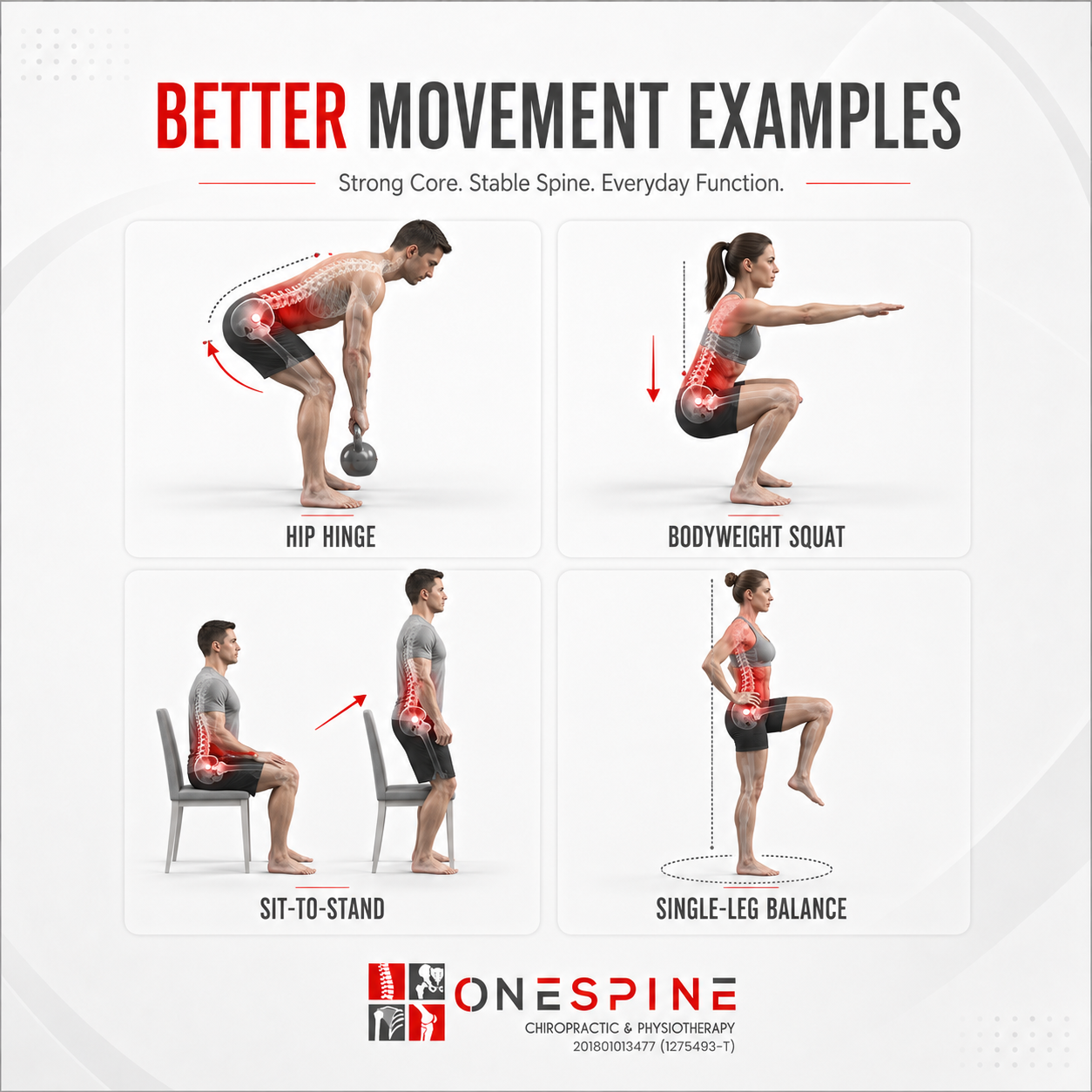
This is where core stability becomes practical. The goal is not only to perform an exercise well in the clinic, but to help the body move better in everyday life.
What to Avoid When You Have Lower Back Pain
Be careful with:
- Fast twisting exercises
- Heavy lifting without control
- Sit-ups during acute pain
- Aggressive planks with poor form
- Exercises that increase leg numbness or tingling
- Pushing through sharp pain
Practical tip: If an exercise makes your lower back tighten more instead of feel supported, your body may be compensating instead of stabilizing.
FAQ
Core stability is often more important at the beginning because it helps control spinal movement and reduce excessive stress on the lower back. Core strength is still useful, but it should usually be built after the body learns better stability, posture control, breathing coordination, and muscle activation.
Yes, you can have strong core muscles and still experience lower back pain if the muscles are not coordinating properly. For example, someone may lift weights well but still feel pain during long sitting, twisting, reaching, or bending because those movements require timing, control, and spinal stability.
Common core stability exercises include dead bugs, bird dogs, pelvic tilts, controlled plank variations, and breathing-based core activation. The best exercise depends on whether your pain is related to weakness, stiffness, nerve irritation, posture strain, hip mechanics, or movement dysfunction.
Chiropractic care may help improve spinal joint mobility, alignment, and mechanical movement. When the spine moves better, physiotherapy rehabilitation can often work more effectively because the body has a better foundation for core activation, posture control, and movement retraining.
Lower back pain may return after strengthening exercises if stability, posture, hip control, or movement coordination has not improved. Strengthening larger muscles without retraining deep stabilizers can allow compensation patterns to continue during sitting, lifting, bending, walking, or exercise.
Conclusion
In summary, core strength helps the body move with power, but core stability helps protect the spine during movement. Our team at One Spine Chiropractic & Physiotherapy supports lower back pain recovery through chiropractic care, physiotherapy rehabilitation, posture correction, personalized core stability training, and muscle recovery therapies designed to restore better spinal support and long-term movement health.



