


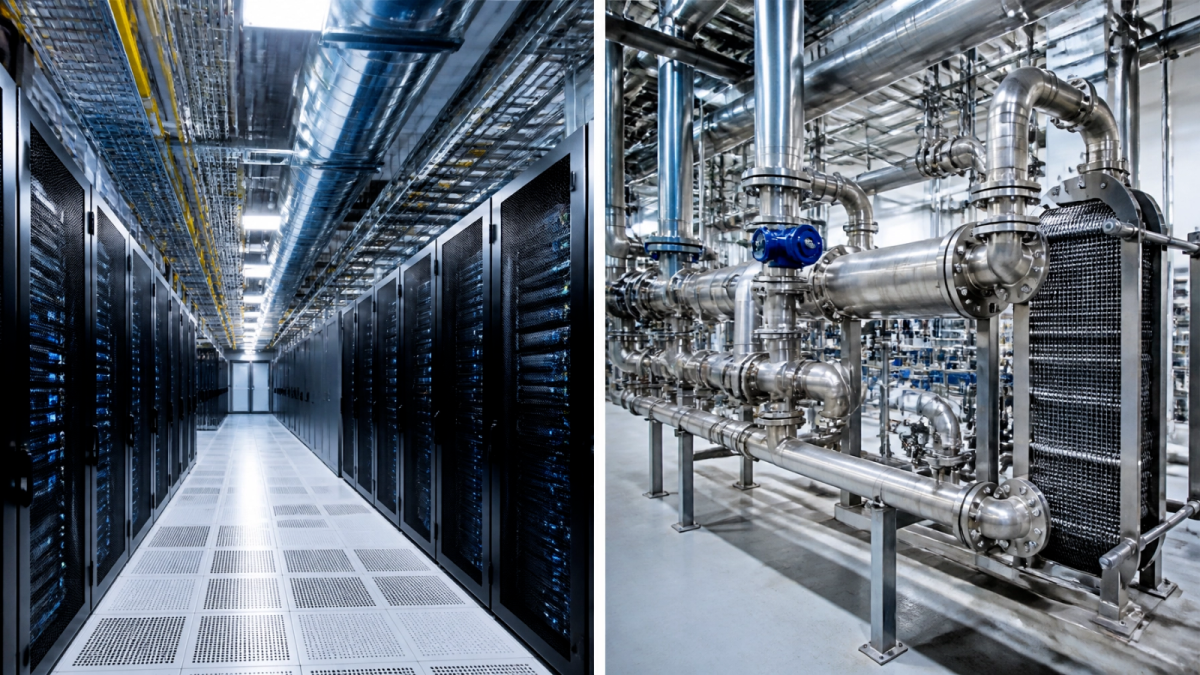


Data Center vs Chemical Plant: Engineering Similarities Explained
At first glance, a data center and a chemical processing plant appear to belong to different sectors. One manages digital information through silicon and high-speed networking, while the other manages physical matter through reactors and stainless steel piping. However, from an engineering perspective, these facilities share more similarities than differences. Both are complex, utility-driven environments where thermal management, safety, and reliability are the primary design drivers.
L-Vision Engineering Pte Ltd provides multi-disciplined services that bridge these sectors, applying rigorous industrial standards to ensure both types of facilities operate with maximum uptime and efficiency.
Direct Answer: Data centers and chemical plants share fundamental engineering principles in thermal management, utility infrastructure, and safety-by-design. Both rely on large-scale industrial cooling systems to reject heat, require highly reliable power and fuel storage (governed by standards like SS 532), and utilize Building Information Modeling (BIM) for complex MEP coordination. While the hazards differ, electrical and thermal in data centers versus chemical and flammable in plants, the engineering methodology for risk mitigation and modular project delivery remains consistent across both industries.
1. Thermal Management and Industrial Cooling Systems
The core function of both a data center and a chemical plant is, effectively, heat management. In a data center, server racks generate immense thermal energy that must be continuously removed to prevent hardware failure. In a chemical plant, process reactions and rotating equipment like compressors generate heat that must be controlled to maintain product quality and safety.
Closed-Loop Cooling Architectures
Both facilities utilize closed-loop cooling systems to manage these thermal loads.
- Primary Loops: These usually involve chilled water or glycol-based fluids circulating through server heat exchangers or process jackets.
- Secondary Loops: Heat is transferred to a secondary loop, often involving industrial cooling towers or dry coolers, where it is rejected into the atmosphere.
The engineering calculations for pump head, flow rates, and N+1 redundancy are virtually identical in both contexts. Organizations like The Green Grid provide global resources for optimizing these cooling efficiencies, which is as critical for a data center's Power Usage Effectiveness (PUE) as it is for a plant's energy intensity metrics.
2. Shared Utility Infrastructure and Regulatory Standards
A significant portion of the capital expenditure for both data centers and chemical plants is dedicated to "plant services" or utilities. These systems must be designed for extreme reliability, as a utility failure can lead to catastrophic data loss or dangerous process upsets.
Fuel Storage and SS 532
Data centers require massive standby diesel generators to maintain uptime during power outages. Chemical plants require fuel for boilers and backup systems. In Singapore, the engineering design for these systems is governed by SS 532, the Singapore Standard specifically for the storage of flammable liquids. This standard dictates strict requirements for:
- Bunding and Containment: Preventing environmental contamination during leaks.
- Fire Separation: Ensuring adequate distance between fuel tanks and critical infrastructure.
- Ventilation: Managing vapor build-up in enclosed generator or pump rooms.
Water and Energy Management
The focus on sustainability has led to the adoption of structured management systems. For data centers, SS 564 (Green Data Centres – Energy and Environmental Management Systems) provides the framework for optimizing energy and water use. In the chemical sector, engineers follow SS 651 (Safety and Health Management System for the Chemical Industry) to manage operational risks, which often overlaps with energy management protocols similar to ISO 50001.
3. Safety-by-Design and Digital Delivery
Safety is the paramount engineering objective in both industries. While the specific hazards vary, chemical plants deal with toxic or reactive materials, while data centers manage high-voltage electrical risks, the methodology for mitigating these risks is the same.
Risk Assessment and Regulatory Compliance
In Singapore, the Ministry of Manpower (MOM) governs workplace safety and health (WSH), including lifting operations and pressure vessel safety. The Singapore Civil Defence Force (SCDF) oversees fire safety and the management of hazardous materials. Engineers use Hazard and Operability (HAZOP) studies to identify potential failure points in both process piping and data center cooling loops.
BIM and Common Data Environment (CDE)
Modern engineering relies on BIM and Common Data Environment (CDE) to coordinate the dense network of piping, cable trays, and ductwork common to both facility types.
- Clash Detection: Essential for ensuring that high-voltage busways in a data center do not interfere with chilled water piping, much like ensuring process lines do not clash with structural steel in a plant.
- Digital Twins: Both sectors use as-built BIM models to create digital twins, allowing for remote monitoring and predictive maintenance.
4. Modular Construction and Commissioning
To meet aggressive project timelines in Singapore and the surrounding region, both industries are shifting toward modular project delivery. This approach involves fabricating complex systems in a controlled factory environment before transporting them to the site.
Advantages of Modular Skids
Whether it is a modular "Power Skirt" for a data center or a chemical dosing skid for a process plant, the engineering benefits include:
- Enhanced Quality Control: Welding and assembly are performed under factory conditions, often to ASME B31.3 standards for process piping.
- Parallel Workflows: Site civil works can proceed while the mechanical and electrical modules are being built off-site.
- Standardized Commissioning: Modules can be pre-tested and "fat-tested" (Factory Acceptance Testing) before arrival, significantly reducing the on-site commissioning phase.
Conclusion
The engineering similarities between data centers and chemical plants demonstrate that the principles of reliability, thermal control, and safety are universal. By leveraging cross-sector expertise, engineers can design more resilient and efficient facilities that meet the rigorous regulatory standards of the Southeast Asian market.
L-Vision Engineering Pte Ltd brings decades of multi-disciplined expertise to both the industrial and digital infrastructure sectors. From front-end engineering design (FEED) to the installation of complex cooling and process systems, we ensure your project is built on a foundation of engineering excellence and regulatory compliance.
Frequently Asked Questions
Can chemical engineers design data center cooling systems? Yes. Data center cooling relies on thermodynamics, fluid mechanics, and heat transfer: core competencies of chemical and mechanical engineers. The transition from managing heat in a chemical reactor to managing heat in a server hall involves many of the same calculations and equipment types, such as heat exchangers and cooling towers.
What role does BIM play in these projects? BIM is the "single source of truth" for design and construction. In both data centers and chemical plants, it allows engineers to perform automated clash detection, simulate construction sequences (4D), and provide owners with an accurate digital twin for long-term facility management.
Why is modular construction preferred for regional growth? Modular construction allows for rapid scalability. In regions like Malaysia or Indonesia, where site labor availability may vary, importing pre-fabricated, pre-tested modules ensures consistent quality and faster speed-to-market for both data center operators and chemical producers.