

The Real Impact of LED Fabric Lightboxes on Store Foot Traffic: Why It Is Changing Retail Visual Strategy in Malaysia
In Malaysia's retail market—whether in KL, Selangor, Penang, Johor Bahru (JB), or Kuantan—there is a very common situation: stores have plenty of passing foot traffic, but low walk-in rates. Many business owners tend to blame pricing, products, or competition. However, in real retail behavior, the core issue is often simpler: customers see the store, but do not visually "notice" it.
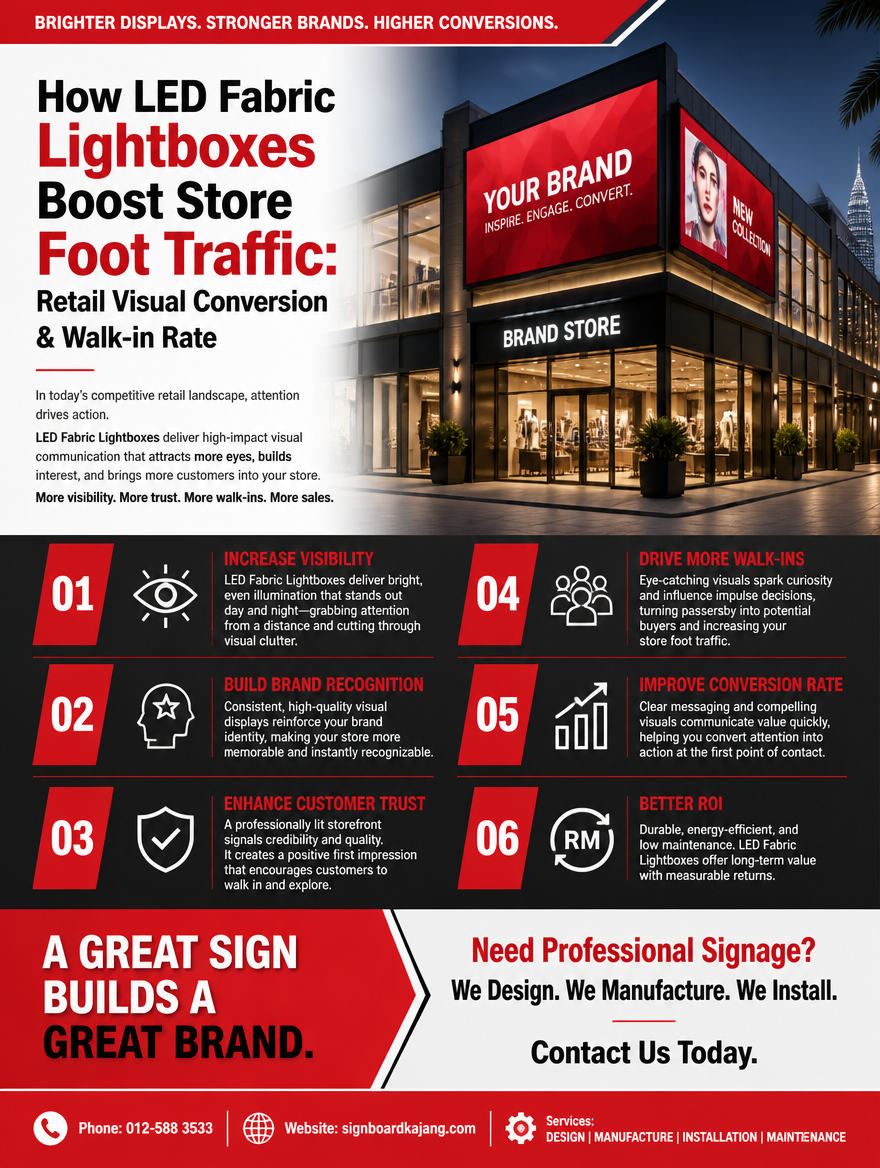
In high-density commercial environments, the human brain automatically filters large amounts of visual information and only responds to elements with high visual contrast, clear recognition, and strong visual focus. As a result, retail competition has shifted toward visual priority competition—this is where the LED Fabric Lightbox has become widely adopted as a modern retail signage solution.
Why Customers "See But Don't Enter": Understanding the Visual Ignorance Mechanism
In shopping streets and mall environments, customer movement patterns are usually very short and fast: Walk past → Scan → Judge → Decide whether to enter. If a storefront lacks strong visual impact, it is often ignored during the "scan" stage.
Main reasons include: too much visual information on the storefront, insufficient lighting emphasis, unclear visual hierarchy, and weak contrast compared to surrounding stores. The LED Fabric Lightbox addresses this by significantly increasing the probability of a storefront being captured by the human visual system—making the store not just seen, but noticed and remembered.
How LED Fabric Lightboxes Improve Store Walk-in Rates
1. Increasing Visual Capture Priority
In fast-moving pedestrian environments, the human brain naturally prioritizes evenly illuminated areas, clearly defined visual edges, and high-contrast visual elements. The LED Fabric Lightbox uses a uniform backlighting system that keeps the visual display consistent and stable, even in visually crowded environments—shifting the store from being "passed by" to being "noticed."
2. From Information Display to Brand Memory
Traditional lightboxes mainly tell customers who you are. LED Fabric Lightbox goes further—making customers remember how your brand feels. Through fabric material and soft, even lighting, it strengthens brand atmosphere, visual consistency, and spatial quality. Especially effective for cafes, beauty & aesthetic clinics, and mid-to-high-end retail brands.
3. Enhancing Marketing Flexibility (A Living Visual System)
One of the biggest advantages is that it is not a fixed signage—it is a continuously updatable visual system. Businesses can easily update visuals for promotional campaigns, seasonal themes (CNY / Hari Raya / Christmas), new product launches, or brand refresh. This transforms signage from a one-time renovation cost into a long-term marketing asset.
Why the Malaysian Market Is Especially Suitable for LED Fabric Lightbox
High density of malls and shoplots (especially KL & Selangor): Visual competition is extremely intense, with multiple brands competing for attention within the same walkway or retail row.
Extremely short customer decision time: Customers typically decide within 3–5 seconds whether to enter a store, making visual impact the primary filter for attracting foot traffic.
Social media-driven consumer behavior: Modern retail spaces increasingly need to support photo-friendly environments, shareable visual designs, and Instagram/TikTok-worthy backdrops—LED Fabric Lightbox fits perfectly into this trend.
What Types of Businesses Benefit Most?
LED Fabric Lightbox delivers the strongest impact for visually driven businesses: Cafes / F&B restaurant brands, Beauty & aesthetic / medical aesthetic clinics, Fashion retail stores & branded outlets, Shopping mall flagship stores (KL / Mid Valley / Pavilion, etc.), and Exhibition booths & event display spaces.
Conclusion
The value of LED Fabric Lightbox goes far beyond lighting upgrades. It helps businesses improve storefront visual priority, strengthen brand recognition, and increase the chance of attracting walk-ins. In essence, it is not just about a lightbox—it's about whether your store gets chosen or ignored.
FAQ
1. Why does LED Fabric Lightbox improve walk-in rates?
Because it increases a store's visual priority, making it easier for customers to notice and be drawn in.
2. Is a brighter lightbox always better?
No. Visibility depends more on visual structure, even lighting, and contrast—not just brightness.
3. Why is LED Fabric Lightbox especially suitable for shopping malls?
Because mall environments are visually crowded, requiring stronger brand distinction to stand out.
4. Is LED Fabric Lightbox suitable for small shops or large brands?
Both. Small shops gain visibility, while large brands strengthen visual consistency across outlets.
5. Will it make a brand look too commercial?
No. The fabric structure and soft lighting actually enhance a more premium, modern brand feel.
Call / WhatsApp Us: 012-588 3533 Website: signboardkajang.com
Disclaimer: Information provided is for reference only. We do not bear responsibility for any inaccuracies or consequences arising from its use.



