





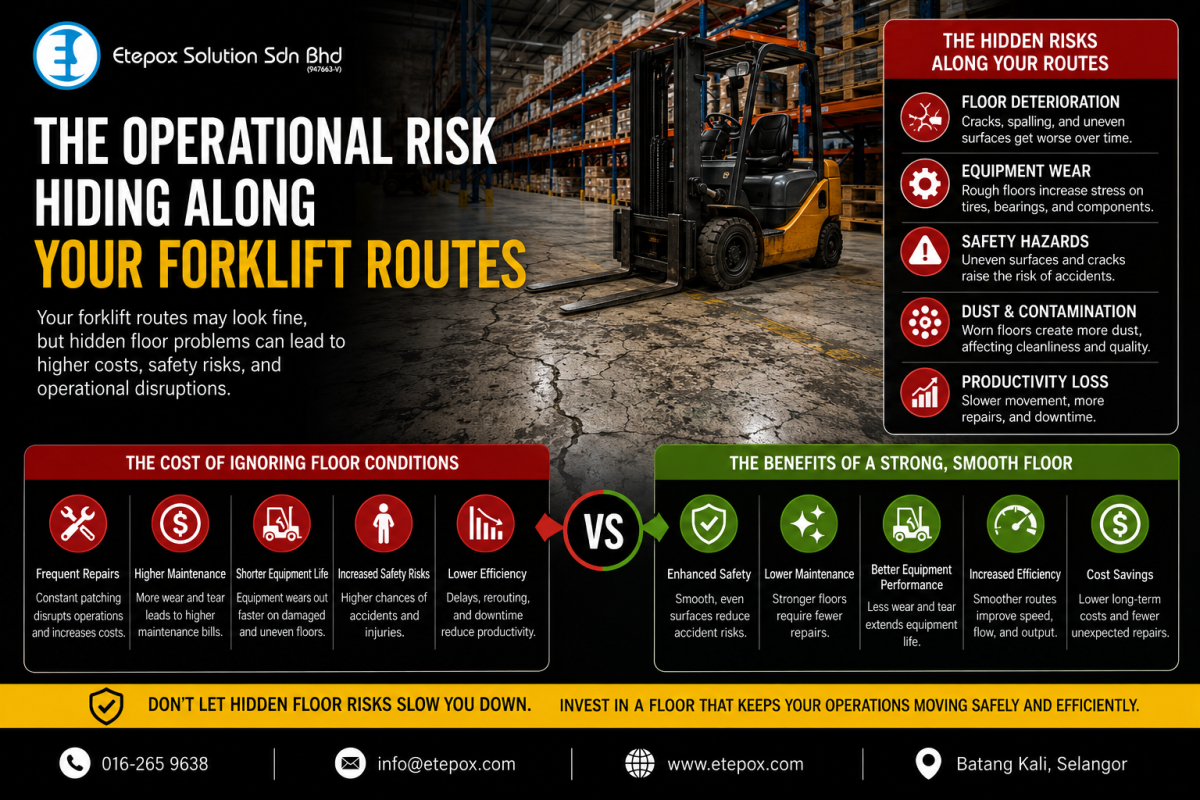
Forklifts are the backbone of most warehouses, factories, and distribution centers.
Every day, they move raw materials, finished goods, pallets, and equipment throughout the facility. Because forklift routes are used so frequently, many businesses assume they are functioning exactly as intended.
However, hidden along these routes is an operational risk that often goes unnoticed until it begins affecting productivity, safety, and maintenance costs.
That risk is deteriorating flooring.
While forklifts may seem capable of handling rough surfaces, the condition of the floor directly impacts how efficiently and safely they operate. Over time, neglected flooring can become one of the most expensive hidden challenges within a facility.
Forklift Routes Experience Constant Stress
Unlike other areas of a warehouse, forklift routes endure continuous traffic.
These routes often handle:
- Heavy pallet loads
- Repeated turning movements
- Sudden braking
- Continuous acceleration
- Long operating hours
Every movement places pressure on the floor surface.
As months and years pass, this constant stress gradually wears down concrete surfaces, especially in high-traffic zones.
Without proper maintenance, forklift routes become the first areas to show signs of deterioration.
Small Surface Damage Creates Bigger Problems
Many facility managers initially notice:
- Hairline cracks
- Surface wear
- Minor spalling
- Uneven joints
- Tire marks
These issues may appear harmless at first.
However, forklifts travel over these defects hundreds of times each day.
The repeated impact causes damage to spread faster than expected.
Eventually, small imperfections can develop into larger repair projects that disrupt operations and increase maintenance expenses.
Equipment Wear Increases
Forklifts are designed to carry heavy loads efficiently.
But rough or damaged flooring forces equipment to work harder.
Uneven surfaces create vibration that can affect:
- Tires
- Bearings
- Hydraulic systems
- Suspension components
- Steering mechanisms
Over time, this additional stress can lead to:
- More frequent repairs
- Increased maintenance costs
- Shorter equipment lifespan
Many businesses focus on maintaining their forklifts without realizing that the floor may be contributing significantly to equipment wear.
Safety Risks Often Develop Gradually
One of the biggest concerns associated with deteriorating forklift routes is safety.
Damaged flooring can increase the risk of:
- Load instability
- Operator discomfort
- Reduced vehicle control
- Trip hazards for pedestrians
- Accidents in high-traffic areas
Because these risks develop gradually, they can become normalized within daily operations.
Unfortunately, what feels routine today can become a serious incident tomorrow.
Productivity Suffers More Than You Realize
Forklift efficiency depends on smooth and predictable travel paths.
When flooring deteriorates, operators often need to:
- Reduce travel speeds
- Avoid damaged areas
- Handle loads more cautiously
- Take longer routes
These adjustments may seem minor individually.
However, when repeated throughout the day across multiple vehicles, they can significantly reduce overall productivity.
Small delays multiplied across hundreds of forklift trips create measurable operational losses.
Dust Along Forklift Routes Creates Additional Challenges
Untreated concrete often produces dust as it wears.
Forklift traffic accelerates this process by continuously grinding the surface.
The result is:
- Increased cleaning requirements
- Dust on inventory
- Reduced facility appearance
- Potential contamination concerns
For businesses focused on operational excellence, dust becomes an ongoing challenge that consumes both time and resources.
Why Polished Concrete Improves Forklift Operations
Many warehouses are upgrading to polished concrete flooring to address these risks.
Polished concrete creates a denser, more durable surface that can better withstand continuous forklift traffic.
Benefits include:
- Reduced surface wear
- Lower dust generation
- Improved durability
- Easier maintenance
- Better safety conditions
- Enhanced operational efficiency
Instead of constantly repairing damaged routes, businesses can create flooring designed to support long-term traffic demands.
Conclusion
Forklift routes are among the busiest areas in any industrial facility.
Because they are used every day, it is easy to overlook the gradual deterioration occurring beneath them.
Yet damaged flooring can quietly affect equipment performance, safety, productivity, maintenance costs, and overall operational efficiency.
The most successful facilities understand that forklift performance is only as reliable as the surface beneath it.
Sometimes the biggest operational risk isn't the forklift itself—it's the route it's driving on every day.



