


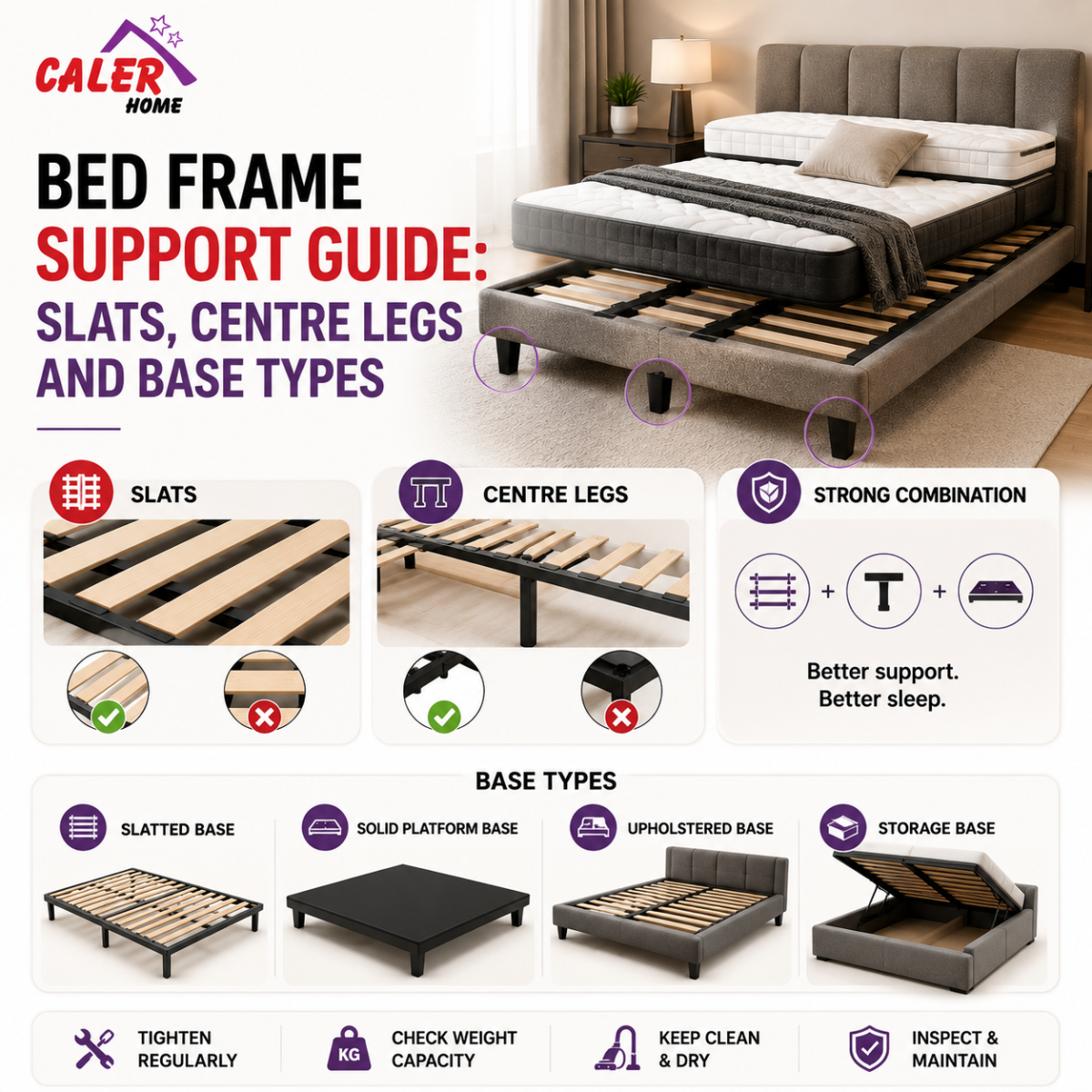
Bed Frame Support Guide: Slats, Centre Legs and Base Types Explained
Bed frame support depends on three main parts: slats, centre legs, and the base type. Choosing the right support system helps keep your mattress level, reduce sagging, improve comfort, and protect both the mattress and bed frame over time.
At Caler Home, our team helps customers choose bed frames based on mattress type, bedroom size, support needs, and daily use. In this guide, we explain how bed slats, centre support legs, and different bed base types work so you can make a more confident buying decision.
Quick Answer: What Makes a Bed Frame Supportive?
A supportive bed frame should hold the mattress evenly, reduce movement, and carry daily weight without bending or shifting. Strong slats, proper slat spacing, centre legs for larger sizes, secure joints, and a suitable base type all help create better mattress support.
| Support Feature | Why It Matters |
|---|---|
| Strong slats | Support the mattress and sleepers |
| Proper slat spacing | Helps reduce sagging |
| Centre support legs | Supports queen and king bed frames |
| Secure side rails | Keeps the frame stable |
| Suitable base type | Matches the mattress support needs |
| Quality hardware | Reduces loosening, noise, and movement |
What Are Bed Slats?
Bed slats are horizontal support pieces placed across the inside of a bed frame. They carry the weight of the mattress and help distribute pressure across the bed.
Slats affect mattress comfort, airflow, and long-term support. Weak or poorly spaced slats can cause sagging, uneven comfort, and noise over time.
Customers comparing bed frame options in Malaysia should check the slat design, spacing, and fixing method before buying.
Wooden Slats Explained
Wooden slats are commonly used because they provide a balance of support, slight flexibility, and comfort. Slight flexibility can help absorb pressure while still supporting the mattress.
Wooden slats are often suitable for:
- Memory foam mattresses
- Hybrid mattresses
- Latex mattresses
- Pocket spring mattresses
The quality of the wood, slat thickness, and spacing are important. Thin or weak slats may bend under pressure, especially when used with a heavy mattress.
Metal Slats Explained
Metal slats are often used in modern or heavy-duty bed frames. They usually offer firm support and require less maintenance than some wooden slat systems.
Metal slats may be suitable for:
- Heavy
3
Metal Slats Explained mattresses
- Higher weight support needs
- Long-term daily use
- Minimal-maintenance bedrooms
However, metal slats still need proper spacing and secure fixing. If the slats are loose or the frame joints are not tight, the bed may squeak or feel unstable.
For customers comparing material choices, our guide on wooden bed frame vs metal bed frame explains the general differences in comfort, maintenance, and daily use.
Why Slat Spacing Matters
Slat spacing affects how well the mattress is supported. Closely spaced slats usually provide better support because they reduce gaps beneath the mattress.
Wide gaps may cause the mattress to sag or dip between slats over time. This is especially important for foam, latex, and hybrid mattresses, which often need more even support.
Before buying, check your mattress manufacturer’s support recommendations. This helps protect mattress comfort and may also help maintain warranty requirements.
Why Centre Support Legs Are Important
Centre support legs help carry weight through the middle of the bed frame. They are especially important for queen and king bed frames because larger mattresses place more pressure across the centre area.
Centre support can help:
- Distribute weight more evenly
- Reduce stress on the side rails
- Prevent middle sagging
- Improve frame balance
- Reduce creaking and wobbling
- Support the mattress for longer
Without enough centre support, larger bed frames may loosen, bend, or become noisy over time. If your mattress is thick or heavy, it helps to read our guide on choosing a bed frame that supports a heavy mattress before making a decision.
Common Bed Base Types Explained
Different bed base types support mattresses in different ways. The best choice depends on your mattress type, room condition, storage needs, and comfort preference.
Slatted Base
A slatted base uses wooden or metal slats to hold the mattress. It allows airflow under the mattress, helps reduce moisture buildup, and works well with many mattress types when the slats are properly spaced.
For Malaysian homes, airflow can be helpful because bedrooms may feel humid. Good ventilation around the mattress can help reduce musty smells and moisture issues.
Solid Platform Base
A solid platform base provides a continuous flat surface under the mattress. It can offer even support across the full mattress area and is often suitable for many foam mattresses.
The main consideration is airflow. Since a solid base has less ventilation than slats, room ventilation becomes more important, especially in humid conditions.
Divan Base
A divan base usually has a solid upholstered structure and may include storage drawers. It can provide firm mattress support while helping save space in compact bedrooms.
For customers living in condos or apartments, our storage bed frame buying guide Malaysia explains how to compare storage function, support structure, and room fit before buying.
Adjustable Base
An adjustable base allows users to raise or lower different parts of the bed for reading, relaxing, or resting. Before buying, always check whether your mattress is compatible with the adjustable mechanism.
Matching the Right Base to Your Mattress
The right base depends on your mattress type. A mattress that is not properly supported may sag, feel uneven, or wear out faster.
| Mattress Type | Recommended Support |
|---|---|
| Memory foam | Closely spaced slats or solid platform base |
| Hybrid | Reinforced slatted base or platform base |
| Pocket spring | Slatted base or platform base |
| Latex | Strong slatted base with proper spacing or solid platform |
If you are choosing a new mattress and bed frame together, our mattress size guide Malaysia can help you compare single, super single, queen, and king sizes before selecting a frame.
What to Look for in a Quality Bed Frame
A quality bed frame should support the mattress properly and stay stable during daily use. The best option is not only about design, but also about how the frame is built.
Before buying, check for:
- Strong slats or a solid base
- Reinforced centre support for larger sizes
- Stable legs
- Secure side rails
- Quality connectors and hardware
- Minimal movement when tested
- Suitable size for your mattress
- Practical weight support for daily use
Our guide on how to check furniture quality before buying in Malaysia can help customers know what to inspect in a showroom before making a purchase.
Common Bed Frame Support Problems to Avoid
Most bed frame support problems start with weak slats, loose joints, poor centre support, or the wrong base type. These issues can lead to sagging, squeaking, wobbling, and discomfort.
Common problems include:
- Slats spaced too far apart
- Centre support missing on larger frames
- Weak side rails
- Loose screws or connectors
- Bed frame not matching the mattress type
- Uneven flooring
- Poor assembly
If your bed already feels unstable, our article on common reasons bed frames break or become noisy explains why these problems happen and how to reduce them.
How Our Team Helps Customers Choose the Right Bed Frame Support
At Caler Home, we help customers choose suitable bed frame support by looking at mattress size, mattress type, bedroom layout, preferred design, and daily use. This helps customers avoid choosing a bed frame that looks suitable but does not support the mattress properly.
Mattress and Frame Matching
Our team helps customers match the bed frame base with the mattress type. This includes checking whether the mattress needs closely spaced slats, a firmer platform, or reinforced centre support.
Bedroom Space Planning
We consider room size, walking space, wardrobe placement, and delivery access before recommending a bed frame. This helps customers choose a frame that fits the room, not just the mattress.
For better planning, our furniture measurement guide Malaysia helps homeowners measure furniture size, bedroom space, and delivery access.
Practical Guidance Before Buying
We explain the difference between slats, centre legs, side rails, and base types in simple terms. This helps customers understand what matters for comfort and long-term use.
Complete Bedroom Solutions
Our team also helps customers coordinate bed frames with mattressesmb-0">We explain the difference between slats, centre legs, side rails, and base types in simple terms. This helps customers understand what matters for comfort and long-term use.
Looking for the Right Bed Frame Support?
Explore durable bed frame options in Malaysia with Caler Home. Our team can help you choose a suitable support system based on your mattress type, bedroom size, and daily use.
Explore Durable Bed Frame Options in MalaysiaFAQ
Both can work well if they match the mattress type. Slats offer better airflow, while a solid base provides a flatter surface. The best choice depends on your mattress material, comfort preference, and support requirements.
Yes, queen and king bed frames usually benefit from centre legs or a centre support beam. This helps reduce sagging in the middle and supports the larger mattress size more evenly.
Slat spacing depends on the mattress manufacturer’s recommendation. In general, closer spacing provides better support, especially for foam, latex, and hybrid mattresses.
Yes, weak or widely spaced slats can cause the mattress to sag, dip, or wear unevenly. Over time, this may affect comfort and reduce mattress lifespan.
A heavy mattress usually needs strong slats or a firm platform base, centre support, stable legs, and secure side rails. The frame should hold the mattress evenly without bending, shifting, or excessive movement.
Conclusion
In summary, bed frame support comes from the slats, centre legs, side rails, joints, and base type working together. Choosing the right support system helps protect your mattress, reduce sagging, improve comfort, and create a better sleeping experience for everyday use.




