


For industrial operators in Singapore, Malaysia, and Indonesia, the transition from a conceptual design to a fully operational facility is one of the most critical phases in a project’s lifecycle. Whether it is a specialty chemical plant on Jurong Island or a large-scale edible oil refinery in Johor, the Process Plant Installation phase dictates the long-term reliability, safety, and profitability of the asset.
Despite the high stakes, many organizations fall into recurring traps that lead to budget overruns, extended timelines, and compromised equipment performance. Since 2001, L-Vision Engineering Pte Ltd has observed that the most successful projects are not necessarily those with the largest budgets, but those that proactively mitigate specific installation risks.
In this guide, we analyze the three most common pitfalls in industrial installation and provide a framework for avoiding them through a multi-disciplinary engineering approach.
1. Inadequate Site Preparation and Infrastructure Assessment
One of the most frequent causes of project "scope creep" is a failure to reconcile the physical realities of the site with the technical requirements of the new equipment. Many installations encounter costly delays because critical constraints: such as access routes, floor loading capacities, and utility availability: were overlooked during the planning phase.
Logistics and Spatial Constraints
It is surprisingly common for high-value Mechanical Equipment Installation to be delayed because a pressurized vessel or a modular skid cannot fit through existing doorways, corridors, or structural openings. In brownfield projects, especially within the dense industrial estates of Singapore, spatial limitations are a primary hurdle. Failure to plan for the "path of travel" from the delivery bay to the final foundation can necessitate emergency wall demolitions or expensive crane maneuvers that were not factored into the initial tender.
Structural and Utility Readiness
Beyond physical dimensions, the structural integrity of the installation site is paramount. Factors such as:
- Floor Levelness and Vibration Isolation: Precision machinery requires specialized foundations. Uneven flooring can lead to shaft misalignment and premature bearing failure.
- Utility Capacity: Does the existing Electrical Installation support the peak load of the new motor drives? Are the compressed air and cooling water headers sized for the additional demand?
To avoid this pitfall, engineering managers must move beyond digital drawings and conduct thorough physical site surveys. Utilizing a Site Readiness Checklist that confirms power availability, permit-to-work (PTW) protocols, and access routes is essential before any equipment arrives on site.

2. Technical Knowledge Gaps in Installation Personnel
A common misconception in industrial procurement is treating Process Plant Installation as a general labor task rather than a specialized engineering discipline. Using installers who lack specific equipment knowledge often results in "hidden" damage: mistakes that are not apparent during the initial power-on but cause catastrophic failure months later.
Precision vs. General Rigging
Installing complex process equipment involves more than just bolting a machine to the floor. It requires a deep understanding of tolerances, thermal expansion, and torque specifications. Common errors observed due to lack of expertise include:
- Incorrect Component Orientation: Installing filters, screens, or check valves in reverse, leading to immediate process blockage.
- Motor and Drive Mismanagement: Burning out high-torque motors by exceeding maximum run times during dry-run testing or failing to check phase rotation.
- Seal Damage: Compromising mechanical seals during the rigging process due to improper lifting points.
The Value of Experienced Engineering Partners
At L-Vision Engineering, we have spent over two decades refining our installation protocols. Our history since 2001 has shown that having a multi-disciplinary team: technicians who understand the intersection of mechanical alignment and electrical control: reduces the risk of rework by up to 30%. When installers understand the "why" behind a specific manufacturer's requirement, they are far more likely to execute the "how" correctly.
For more information on specialized plant services, visit our Process Plant Installation page.
3. Fragmented System Integration and Utility Mismatch
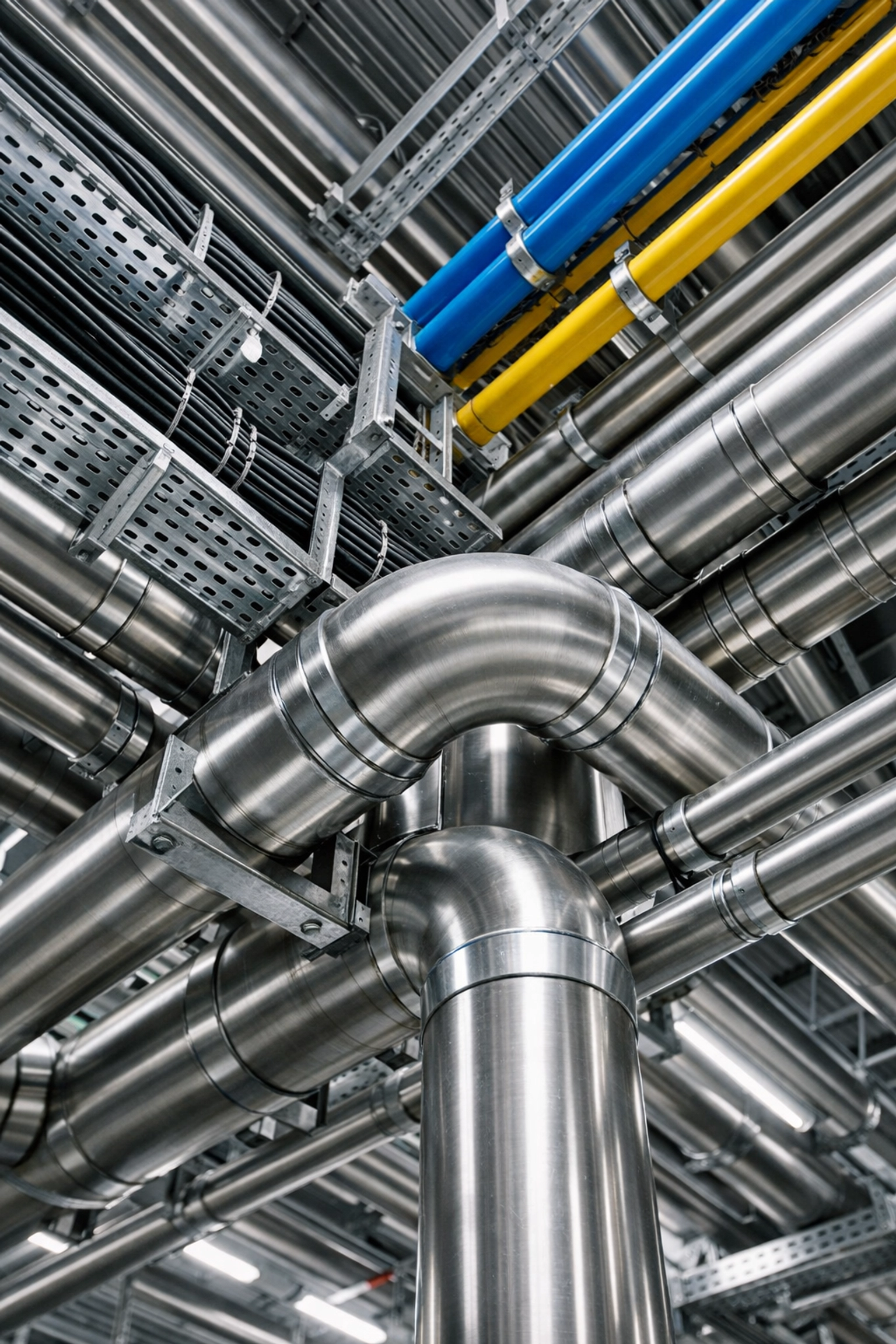
The third major pitfall is treating the installation of a new machine as an isolated event rather than an integration into a broader ecosystem. A process plant is a symbiotic network of fluids, gases, electricity, and data. When Process & Utility Piping Installation is handled separately from the mechanical setup without proper coordination, the result is often a bottlenecked system.
Flow Rate and Pressure Dynamics
A new centrifuge or heat exchanger may meet its individual specifications, but if the interconnecting piping is undersized or contains excessive bends, the resulting pressure drop can render the system inefficient. Engineers must calculate both average and peak flow rates to ensure that the utility headers can support the new demand without starving existing processes.
Electrical and Control Synchronization
In modern Industry 4.0 environments, the Electrical Installation must do more than just provide power; it must facilitate communication between the new equipment and the plant’s existing Distributed Control System (DCS) or SCADA. Pitfalls here include:
- Incompatible Signal Protocols: Attempting to integrate legacy analog sensors with modern digital fieldbus systems without appropriate gateways.
- Inadequate Power Quality: Failing to account for the harmonic distortion introduced by new Variable Frequency Drives (VFDs), which can interfere with sensitive electronic instrumentation nearby.
Integration Comparison Table
To help engineering managers evaluate their approach, the following table compares a fragmented installation versus an integrated engineering approach:
| Feature | Fragmented Installation (Ad-hoc) | Integrated Engineering (L-Vision Model) |
|---|---|---|
| Project Management | Multiple contractors; high risk of "finger-pointing." | Single-point responsibility via Project Management. |
| Piping & Utilities | Installed based on "path of least resistance." | Sized for hydraulic efficiency and future expansion. |
| Regulatory Compliance | Checked post-installation; risk of non-compliance. | Integrated into design (SCDF, MOM, SS Standards). |
| Commissioning | Long, bug-ridden startup periods. | Systematic testing from Digital Delivery to onsite. |
How L-Vision Engineering Ensures Installation Success
Avoiding these pitfalls requires a partner that looks beyond the immediate task of "bolting and piping." L-Vision Engineering Pte Ltd adopts a holistic, multi-disciplinary approach that spans the entire project lifecycle, from Plant Engineering Design to final handover.
Our Multi-Disciplinary Expertise
By maintaining in-house expertise across Mechanical, Piping, and Electrical disciplines, we eliminate the communication gaps that lead to integration failures. Our teams are well-versed in the unique regulatory landscapes of Singapore (such as SCDF requirements for flammable liquid storage) and the logistical challenges of operating in Malaysia and Indonesia.
Strategic Recommendations for Engineering Managers
- Prioritize FEED: Engage in Front-End Engineering Design to identify spatial and utility constraints before procurement begins. You can read more about this in our article on EPC vs. EPCM models.
- Verify Contractor Track Records: Ensure your installation partner has specific experience in your industry (e.g., food-grade sanitary piping vs. high-pressure chemical lines).
- Insist on Comprehensive Documentation: Ensure that at the end of the installation, you receive updated P&IDs, electrical schematics, and maintenance manuals that reflect the "as-built" reality.
Conclusion
The installation of a process plant is the ultimate test of an engineering design. By addressing site readiness, ensuring technical expertise, and focusing on seamless system integration, companies can avoid the most common pitfalls that drain capital and delay market entry.
Since 2001, L-Vision Engineering has been the trusted partner for complex industrial installations across Southeast Asia. Our commitment to professional excellence and technical accuracy ensures that your facility is built to perform from day one.
For more updates on industrial engineering trends and project highlights, visit our Latest News section or explore our comprehensive Sitemap to find the specific service your facility requires.



