

Building Energy-Efficient Chain Store Signs: LED Letters vs Lightbox – A Complete Power Consumption Comparison
For a single-outlet business, the electricity cost of running an illuminated signboard is a minor operational consideration. For a chain brand with twenty outlets across KL, Selangor, Penang, JB, and beyond, that same cost is multiplied twenty times over — running continuously, every evening, every month, for the entire operational life of the sign.
The choice between 3D LED channel letters and a lightbox signboard is not just a visual decision — it is an energy economics decision that compounds significantly as the outlet network grows. A chain that selects the more efficient signage type and specifies it correctly across all outlets captures an electricity saving that appears on the P&L of every outlet, every month, for as long as the sign operates.
This article provides a practical, data-based comparison of the two most widely used illuminated signage formats in Malaysian commercial signage — examining the physics of their energy consumption, their relative performance across different outlet scenarios, and a framework for deciding which approach serves each brand type most effectively.
Part 1: Understanding the Two Signage Systems
3D LED Channel Letters: Targeted Illumination
LED channel letters (also known as 3D illuminated letters or box-up letters) are individually fabricated letterforms — each letter is a sealed enclosure housing LED modules that illuminate the letter face from within. The fundamental energy efficiency principle is elegantly simple: only the letter area itself is illuminated. The background, the panel borders, the space between letters — none of it draws power.
How They Work
- Each letter is an independent lighting unit — containing its own LED strip or module array, driver, and wiring termination
- The acrylic letter face diffuses the LED output evenly across the letter surface, eliminating visible hot spots
- LED modules are positioned to deliver the specified brightness at the specified colour temperature — with the driver regulating voltage and current to maintain consistent performance
- The letter body — typically aluminium or acrylic — acts as a heat sink, managing thermal output and extending LED lifespan
Available Illumination Configurations
- Front-lit: LEDs face the acrylic front face — maximum brightness, highest daytime and nighttime visibility, appropriate for road-facing and high ambient light environments
- Halo backlit: LEDs face the wall behind the letter — creating an outline glow effect that communicates premium positioning. Lower apparent brightness than front-lit but significantly higher perceived quality
- Combined front and back: Dual-sided illumination — used where both maximum visibility and premium appearance are required simultaneously
鬣 Lightbox Signboard: Full-Panel Illumination
A lightbox signboard is an enclosed panel — typically an Aluminium Composite Panel (ACP) frame with a translucent face — that is internally illuminated by LED strip arrays running across the full panel area. Unlike channel letters, the lightbox illuminates the entire sign face uniformly — brand name, logo, background panel, and all surrounding space receive the same illumination.
How They Work
- LED strips run across the full internal panel area — typically mounted on aluminium rails at regular spacing intervals to achieve even light distribution
- The spacing between LED strip rows determines illumination uniformity — closer spacing reduces visible banding but increases LED count and power consumption
- The panel face — acrylic or polycarbonate — diffuses the LED output to eliminate visible strip lines at the viewing surface
- Graphics are applied to the panel face using UV direct printing or vinyl film — the backlight illuminates through the graphic layer
Configurations
- Single-face lightbox: Wall-mounted, illuminated on one face — the standard configuration for shopfront fascia applications
- Double-face lightbox: Illuminated on both faces — for hanging or projecting sign applications where visibility from multiple directions is required
- LED fabric lightbox: Fabric graphic face with edge-lit or back-lit LED system — the most advanced configuration, producing the most even and high-quality illumination
Part 2: The Energy Consumption Comparison — Where the Numbers Tell the Story
Factor 1: Illuminated Area — The Primary Determinant of Power Consumption
The most fundamental energy efficiency difference between LED channel letters and lightboxes is not the quality of the LED modules used — it is the area that needs to be illuminated.
Consider a standard shopfront sign panel of 3,000mm × 700mm (a common size for a Malaysian shophouse or shoplet). The full panel area is 2.1 square metres.
- For a lightbox sign using this panel: the entire 2.1 square metres is illuminated. Every square centimetre of background, every space between letters, every border area — all require LED coverage
- For LED channel letters on the same shopfront: only the letter area is illuminated — typically 20–35% of the total panel area for a well-proportioned brand name in a legible letter size
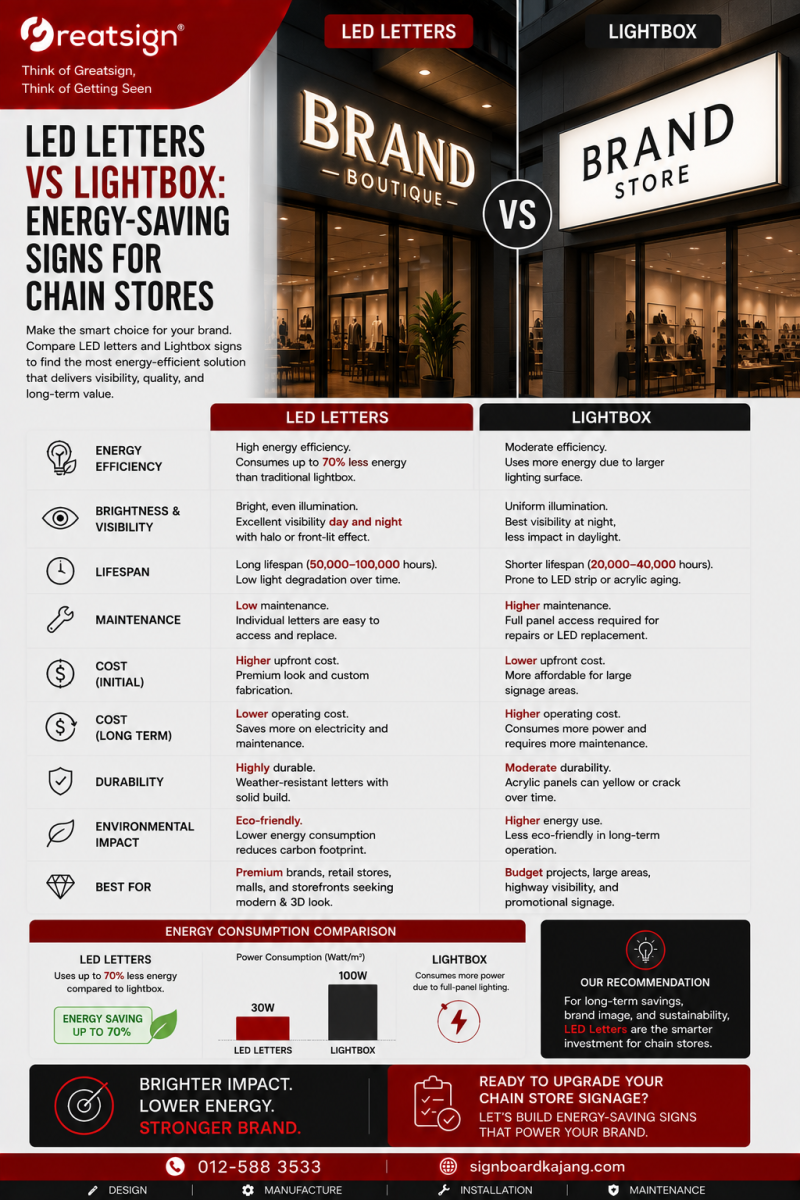
The energy consumed is proportional to the illuminated area. Everything else being equal, a lightbox sign for this panel requires approximately 3–5 times more LED output — and therefore 3–5 times more electrical power — than equivalent LED channel letters.
Factor 2: LED Module Count — More Area = More Modules = More Power
The quantitative difference becomes clearer when examining the LED module count required for each approach on the same shopfront:
| Parameter | LED Channel Letters | Lightbox Sign |
|---|---|---|
| LEDs per letter (typical) | 5–20 modules per letter | Not applicable |
| LED strips (full panel) | Not applicable | Dozens to hundreds of strip sections |
| Total LED count (10ft sign) | ~40–120 modules | ~200–800+ modules |
| Power per LED module | Similar — depends on spec | Similar — depends on spec |
| Total power draw | 25–80W | 150–350W |
| Monthly electricity cost (8hrs/day, RM0.50/kWh) | ~RM3–10 | ~RM18–42 |
Factor 3: The Chain Brand Multiplication Effect
The monthly electricity difference per outlet — perhaps RM15–30 per month — appears manageable for a single location. The significance changes dramatically when multiplied across a chain network:
| Network Size | Monthly Saving (LED Letters vs Lightbox) | Annual Saving |
|---|---|---|
| 5 outlets | ~RM75–150 | ~RM900–1,800 |
| 20 outlets | ~RM300–600 | ~RM3,600–7,200 |
| 50 outlets | ~RM750–1,500 | ~RM9,000–18,000 |
| 100 outlets | ~RM1,500–3,000 | ~RM18,000–36,000 |
For a chain brand with 50 or more outlets, the signage energy decision is worth up to RM18,000 per year — before factoring in the reduced maintenance load from operating fewer total LED modules.
Part 3: Which Format Is Right for Each Scenario?
Scenario A: Energy Efficiency is the Priority → LED Channel Letters
For chain brands where brand name recognition is the primary signage objective, and where the sign does not need to display extensive graphic content, promotional imagery, or detailed product information, LED channel letters deliver superior energy efficiency with equivalent or better brand visibility.
Recommended brand types:
- F&B chains with strong, recognisable brand names
- Convenience stores, pharmacies, and service businesses
- Education centres and training institutes
- Gyms, fitness studios, and wellness businesses
- Any brand where the primary sign objective is brand name recognition rather than promotional content display
Key advantages over lightbox: 60–75% lower electricity consumption, longer effective LED lifespan (individual letters can be serviced without dismantling the full installation), premium dimensional visual quality, and a modern appearance that communicates brand investment.
Scenario B: Large-Format Visual Impact is the Priority → Lightbox
For brands where the signage must communicate more than just the brand name — where promotional content, product imagery, or detailed service information is part of the sign's function — a lightbox provides the full-panel graphic capability that channel letters cannot.
Recommended brand types and applications:
- Shopping mall fascia where graphic panels are specified by the mall's tenancy guidelines
- F&B brands with strong visual menu or product photography elements
- Retailers requiring seasonal promotional panel changes
- Any application where the sign displays more than the brand name and descriptor
Energy optimisation for lightbox installations: Specify LED fabric lightbox systems (edge-lit) over traditional strip-lit systems — fabric lightboxes with edge-lit LED can reduce power consumption by 30–40% versus equivalent strip-lit lightboxes while delivering superior graphic quality and even illumination.
Scenario C: Both Brand Identity and Content Display → Hybrid Approach
Many Malaysian chain brands benefit from a hybrid signage system that deploys LED channel letters for the primary brand name and logo (delivering energy efficiency and dimensional quality), combined with a smaller lightbox panel for secondary promotional or product content (delivering graphic flexibility where it is actually needed).
Configuration examples:
- Primary: 3D LED channel letters for brand name (energy-efficient, premium appearance)
- Secondary: Small lightbox panel below or beside the main sign for current promotion or product image
- Result: Brand identity with graphic flexibility, at total power consumption significantly below a full-panel lightbox covering the same shopfront area
Energy saving of hybrid vs full lightbox: Typically 40–60% reduction in total signage electricity consumption while maintaining promotional flexibility.
Part 4: Making the Right Specification for Your Chain
LED Colour Temperature — The Consistency Factor That Multiplies Across the Network
Regardless of which format is selected, LED colour temperature standardisation across all outlets is one of the most commercially important specifications a chain brand HQ can make. Inconsistent colour temperature — caused by different outlets using different LED brands or specifications — produces the most visible and most damaging form of brand inconsistency in illuminated signage.
- Warm white (2700–3200K): Inviting, comfortable, atmospheric — appropriate for hospitality, F&B, and lifestyle brands where warmth is part of the brand experience
- Neutral white (3500–4500K): Balanced, professional, versatile — the most widely applicable specification across retail, professional services, and general commercial applications
- Cool white (5000–6500K): Crisp, energetic, maximum apparent brightness — appropriate for technology brands, clinical environments, and any application where visual clarity at distance is the primary objective
Specify the colour temperature in Kelvin — not as "warm" or "cool" — and document the approved LED module brand and model number in the Signage Guideline. This is the only reliable way to ensure that outlets in different cities, produced by different installers, achieve the same visual result at night.
5 Key Specification Questions Before Ordering
- What is the sign's primary function — brand name recognition, or content and graphic display?
- Does the mall or building management specify a lightbox format that cannot be substituted?
- What LED colour temperature has been standardised across the brand's existing outlets?
- Is there an approved LED module brand and product code specified in the Signage Guideline?
- How many outlets will use this specification — and has the energy saving been modelled at network scale?
Summary: The Energy-Efficient Signage Decision Framework
| Decision Factor | Choose LED Channel Letters | Choose Lightbox | Choose Hybrid |
|---|---|---|---|
| Primary sign function | Brand name and logo recognition | Graphic content + brand | Both simultaneously |
| Energy efficiency priority | High — maximum efficiency | Lower — full panel illumination | Medium — balanced |
| Visual quality target | Dimensional, premium, modern | High brightness, even graphic panel | Premium identity + graphic flexibility |
| Mall/building restriction | Where permitted | Where specified by management | Where both elements are permitted |
| Chain network size | Most energy-efficient at scale | Higher energy cost at scale | Best balance at medium-large scale |
For most Malaysian chain brands where the primary signage objective is brand name recognition, LED channel letters deliver the most commercially efficient combination of energy performance, visual quality, and long-term maintenance cost — at any network scale.
FAQ
1. Can LED channel letters and lightbox signs use the same LED colour temperature specification?
Yes — and for chain brands that use both formats across different outlet types, specifying the same colour temperature for both is essential for visual consistency. The same 4000K neutral white specification applied to LED channel letters at one outlet type and a lightbox panel at another outlet type will produce a consistent brand appearance at night across both — provided the same LED module brand and product line is used for both applications. The colour temperature consistency is determined by the LED module specification, not by the sign format.
2. Does a lightbox sign always consume more electricity than LED channel letters?
As a general rule, yes — because the lightbox must illuminate a larger total area. However, the gap narrows for signs where the brand name occupies a large proportion of the total panel area, or where the LED channel letters are very large and use high-power modules. For typical Malaysian commercial shopfront applications — brand names at 300–500mm letter height on a standard fascia panel — LED channel letters consume significantly less electricity than an equivalent lightbox covering the same panel dimensions.
3. How does a programmable timer or dimmer control affect energy savings?
Significantly. Both LED channel letters and lightboxes benefit from a programmable timer control system that switches signs to reduced brightness or switches them off during the lowest-traffic hours. For a sign operating 12 hours per day without a timer versus the same sign operating 8 hours with a timer switched off for the remaining 4 hours, the timer delivers a 33% reduction in electricity consumption — on top of whatever efficiency advantage the sign type itself provides. For chain brands with centralised management capability, a remote-managed dimming system that adjusts brightness across all outlets simultaneously based on a defined schedule adds further energy optimisation without requiring outlet-level intervention.
4. Are there situations where a lightbox is the more practical choice despite higher energy consumption?
Yes — several. When mall management guidelines specify a lightbox format as a tenancy condition, the format choice is determined by the lease rather than by energy preference. When the sign needs to display regularly updated promotional graphics — seasonal campaigns, limited-time offers, new product launches — the graphic replacement flexibility of a lightbox panel (replacing the printed face insert) is significantly more cost-effective than reproducing dimensional LED letters for each campaign. And when the sign is required to communicate substantial text or image content beyond the brand name and descriptor, the full-panel graphic capability of the lightbox is the appropriate technical solution regardless of its energy profile.
5. What is the correct approach to maintaining consistent LED colour temperature as older modules are replaced?
The most reliable approach is to source replacement LED modules from the same manufacturer and product line as the original installation, and to specify that replacement modules must be drawn from the same production batch where possible — since even within the same product line, between-batch colour temperature variation can be visible in a sign face. Maintaining a record of the original LED module brand, model number, and batch details at each outlet installation is therefore not just a maintenance best practice — it is a brand consistency requirement that should be a standard item in every outlet's installation documentation. If the original module model has been discontinued, obtain LED colour meter readings of an existing module before ordering replacements and match the reading rather than the product code.
If you're not sure where to start, reach out to Great Sign Advertising (M) Sdn Bhd — we offer a free energy efficiency consultation for chain brands across Malaysia, covering LED letter vs lightbox selection, colour temperature standardisation, and network-scale energy saving calculations.
- LED channel letters, lightboxes, and hybrid systems — all produced factory direct
- Consistent LED specification across all outlets — same module, same colour temperature, same brightness
- Service coverage: KL|Selangor|Penang|JB|Melaka|Ipoh|Kuantan
012-588 3533 www.signboardkajang.com
Disclaimer: Information provided is for reference only. We do not bear responsibility for any inaccuracies or consequences arising from its use.



