


Quantum cryptography uses the quantum properties of particles including photons to help encrypt and decrypt messages in a theoretically unhackable way. Scientists worldwide are now endeavoring to cultivate satellite-based quantum communications networks for a global real-time quantum Internet.
Still, prior experiments with long-distance quantum communications links through the air were principally conducted at night because sunlight serves as a source of noise. Previously, “the maximum range for daytime free-space quantum communication was 10 kilometers,” says study co-senior author Qiang Zhang, a quantum physicist at the University of Science and Technology of China, in Shanghai.
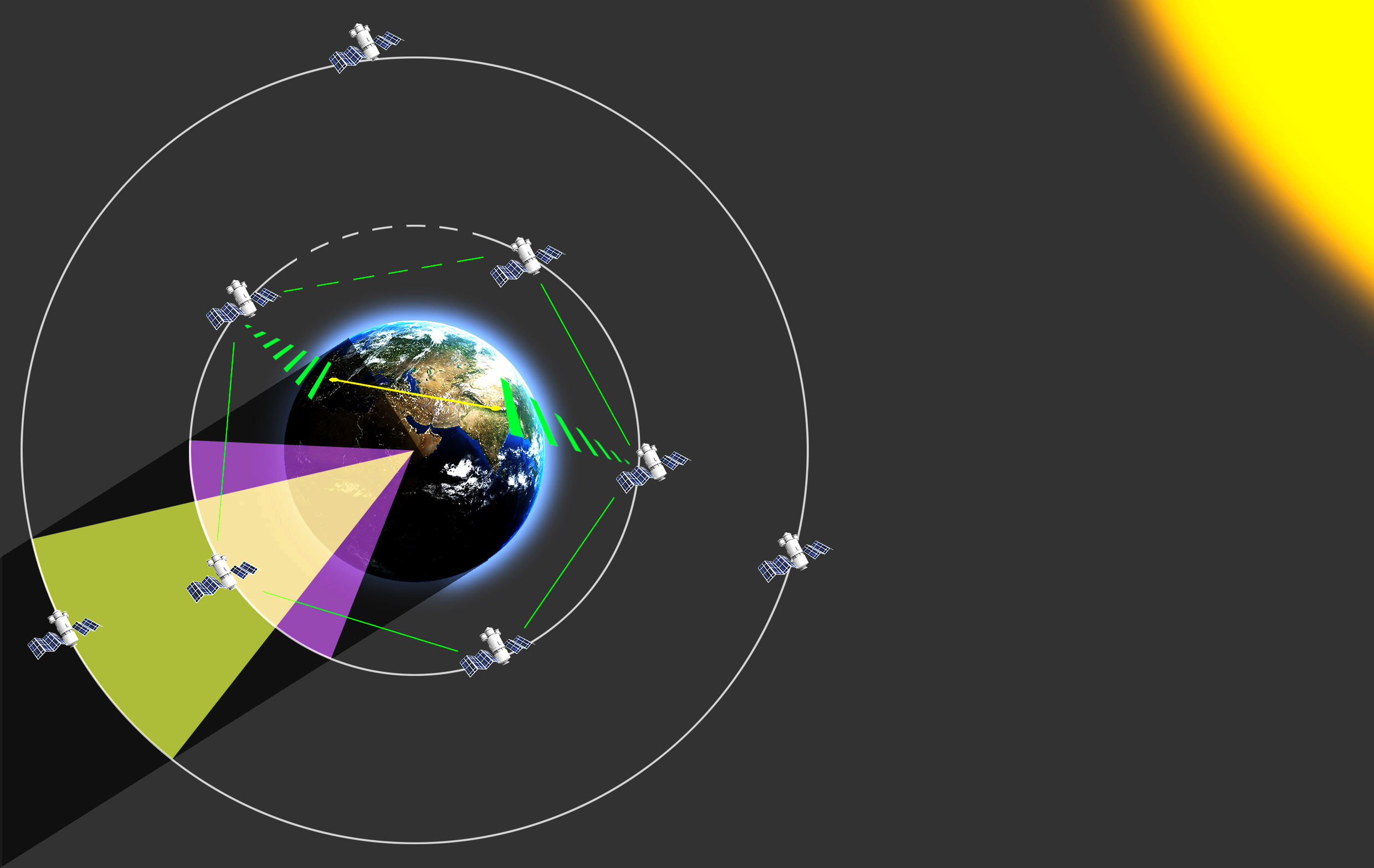
Now researchers led by quantum physicist Jian-Wei Pan at the University of Science and Technology of China, at Hefei, have successfully established 53-kilometer quantum cryptography links during the day between two ground stations. This research advocates that such links could work between a satellite and either a ground station or another satellite, they say.
To conquer interference from sunlight, the researchers switched from the approximately 700- to 900-nanometer wavelengths of light used in all prior day-time free-space experiments to nearly 1,550 nm. The sun is about one-fifth as bright at 1,550 nm as it is at 800 nm, and 1,550-nm light can also pass through Earth's atmosphere with virtually no interference. More over, this wavelength is also presently broadly used in telecommunications, making it more suitable with existing networks.
Previous research was tentative to use 1,550-nm light because of a lack of good commercial single-photon detectors able of working at this wavelength. But the Shanghai group developed a compact single-photon detector for 1,550-nm light that could work at room temperature. In addition to that, the scientists developed a receiver that required less than one tenth of the field of view that receivers for nighttime quantum communications links usually need to work. This limited the amount of noise from stray light by a factor of several hundred.
In experiments, the scientists continually established quantum communications links across Qinghai Lake, the biggest lake in China, from 3:30 p.m. to 5 p.m. local time on several sunny days, achieving transmission rates of 20 to 400 bits per second. Moreover, they could establish these links despite roughly 48 decibels of loss in their communications channel, which is even more than the roughly 40 to 45 dB of loss typically seen in communications channels between satellites and the ground and between low-Earth-orbit satellites, Zhang says. Comparing, original daytime free-space quantum communications experiments could accommodate roughly only 20 dB of noise.
The researchers observe that their experiments were performed in good weather, and that quantum communication is currently impossible in bad weather with today’s technology. Still, they note that bad weather is a problem only for ground-to-space links, and that it would not pose a problem for links between satellites.
In the future, the researchers anticipate to boost transmission rates and distance using better single-photon detectors, perhaps superconducting ones. They may also seek to exploit the quantum phenomenon known as entanglement to carry out more sophisticated forms of quantum cryptography, although this will expect generating very bright sources of entangled photons that can operate in a narrow band of wavelengths, Zhang says.
Source: Tronserve



