


Handle Boxes with Inserts for Parts That Cannot Mix
Small parts handling becomes expensive when screws, jigs, sample pieces or cleaned components leave one station neatly and arrive at the next station mixed together. Hup Hing manufactures stainless steel Handle Box with Insert Set units for electronics, lab, cleanroom and industrial teams that need washable storage with fixed separation inside the box. The practical design discussion should start with part size, drainage, glove access and whether the insert is used for temporary sorting, wet transfer or controlled return after inspection.

Why do small parts still get mixed inside a stainless box?
The usual failure is not the box material; it is the inside layout. If the insert panels are too low, too wide apart or difficult to remove for cleaning, operators eventually use the box as one open container.
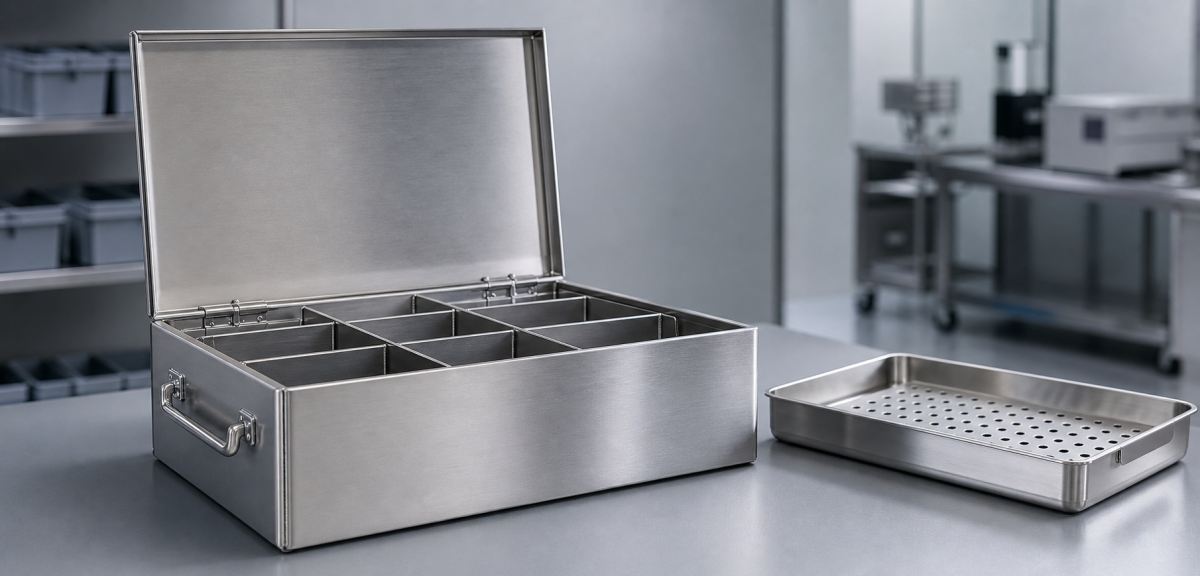
The real Hup Hing product shows a rectangular stainless steel box with a hinged open lid, smooth folded walls, internal divider panels and a separate shallow tray fitted with a perforated plate. That combination supports storage, draining and retrieval when the insert geometry follows the part rather than a generic grid.
| Design point | Practical specification to confirm | Effect on daily handling |
|---|---|---|
| Body material | SUS304 for many clean handling areas; SUS316 if chemical exposure is stronger | Matches corrosion resistance to wash liquid and room humidity |
| Insert layout | Removable or fixed divider panels sized from the actual part footprint | Prevents mixing while keeping each compartment reachable by hand |
| Perforated tray | Hole size and open area matched to part size and liquid drainage | Allows rinsing or drying without losing small components through the plate |
| Fabrication finish | Folded edges, TIG-welded corners, deburred holes and brushed stainless surface | Improves cleanability and reduces sharp contact points during transfer |
How should the insert pattern be drawn before fabrication?
Start with a real sample of the part or a simple footprint sketch. A good insert pattern shows the longest part, the smallest part, the number of pieces per compartment and the direction operators use to lift them out.
For wet handling, the drawing should also show where liquid drains after rinsing. A perforated plate with holes that look tidy in a photo can still fail if the holes catch burrs, trap residue or allow small parts to tilt and jam during unloading.

A handle box drawing is only complete when it shows the part path: loaded, washed, drained, checked and returned.
Which stainless details make the box easier to clean after use?
Cleanability depends on corners and openings more than outside shine. Folded top edges, smooth internal welds, deburred perforations and removable inserts help operators wipe the box without leaving residue under divider corners.
A hairline brushed finish is often practical for daily wipe-down because it hides light handling marks better than mirror polish. Where the box sees stronger chemicals, SUS316 and smoother internal finishing should be discussed before Hup Hing releases the fabrication drawing.
When is a perforated insert safer than a flat base?
A flat base is suitable when the box is only used for dry sorting. A perforated insert becomes useful when components are rinsed, blown dry or moved between wet and dry stations, because liquid can drain away while parts remain separated.
The perforation size should never be selected by appearance alone. It must be smaller than the smallest loose item, large enough for drainage and strong enough to avoid flexing when the box is lifted with a loaded insert set.
What should be included in the enquiry so the box fits the line?
Include the part photo, quantity per box, smallest loose dimension, cleaning liquid, whether the insert must be removable, and how the lid is used during storage. If the box sits beside an inspection table, washing tank or trolley, include the available space and operator hand direction.
Useful references include the Handle Box with Insert Set product page, Hup Hing¡¯s Our Products listing and the company background on About Us. Hup Hing is trusted since 1980 and provides custom stainless steel fabrication for cleanroom, lab, hospital, kitchen and industrial equipment from its Seremban base; for Malaysia-wide enquiries, WhatsApp or call +6016-330 2905, or email info@huphing.my with the part sample and insert requirement.
Can the insert be removable for washing?
Yes. Removable inserts can be discussed when the cleaning method, part size and handling direction are known before fabrication.
Should the box use SUS304 or SUS316?
SUS304 is practical for many dry or light wash areas. SUS316 should be considered when chemicals, stronger rinse routines or more aggressive corrosion exposure are expected.



