


High-resolution, high-frame-rate devices in wireless applications, such as home security cameras, that require frequent battery changes or charging can lead to unsatisfactory user experiences, even when streaming at full quality. Connecting flow sensors to MIPI helps designers balance performance and power consumption by leveraging various operating modes—high-speed, ultra-low-power, or somewhere in between.
By combining the principles of low-duty-cycle sensors with the flexibility of MIPI D-PHY and CSI-2 interfaces, lossless streaming performance up to 290 fps can be achieved, while reducing resolution and frame rate where appropriate to save energy.
Part 1
MIPI and Low-Duty-Cycle Sensor Principles
The MIPI Consortium was founded to shape the data interface for mobile devices, with extending battery life being a top priority. With the widespread adoption of smartphone cameras and displays, MIPI has become the de facto standard for these applications. MIPI-based cameras are increasingly being adopted in non-mobile applications, including automotive, IoT, virtual reality (VR), augmented reality (AR), industrial, and medical applications.
MIPI D-PHY and MIPI C-PHY modules feature two optimized PHYs controlled by a state machine that manages high-speed, low-power, and ultra-low-power states, including complete shutdown during data communication to conserve power and remain inactive.
Many sensor applications are well-suited to this low duty cycle configuration. Work bursts occur around new sensor samples and can be random or periodic.
Random sampling provides a snapshot of the sensor's current state, such as pressing a button to read a temperature reading.
Periodic sampling repeats sensor readings at specific time intervals. Architects choose periodic sampling for three reasons: correlating time-domain analysis over a known timescale, filtering or analyzing signals in the frequency domain, or digitizing and processing signals before converting them back to a human-friendly analog format.
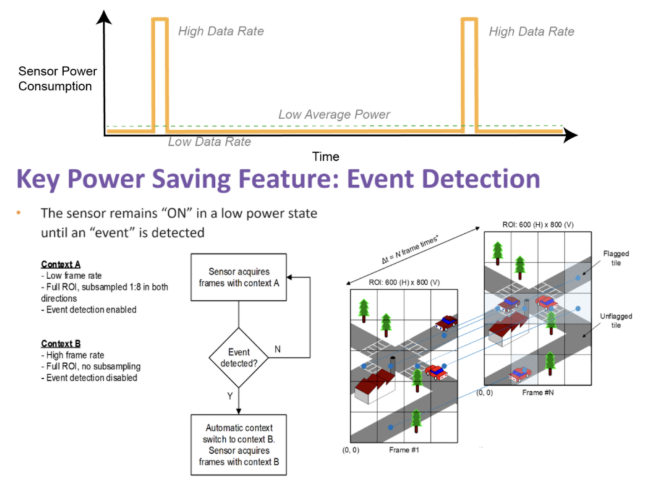
The concept of a dual-imaging sensor operating environment significantly reduces MIPI transfer rates by subsampling across the entire region of interest, thereby reducing frame rates and pixel counts. The ultra-low-power sensor context awaits an event, such as object movement. Detecting the event switches the sensor, MIPI interface, and processor to a full-power environment, sampling all pixels in the region of interest, achieving high frame rates, correspondingly high-speed data transfer rates, and enhanced object tracking.
When the event condition subsides, the stream chain returns to the low-power context, awaiting another event. Power savings of 20x or more can be achieved between sensor environments, and the lower duty cycle significantly reduces its average power consumption.
Part 2
Mira050 Image Sensor
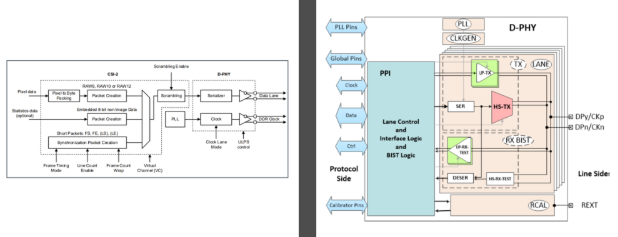
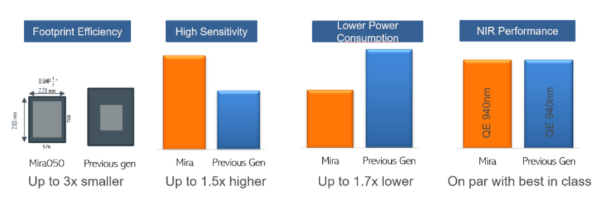
The ams Osram Mira050 is a 0.5-megapixel, global shutter back-illuminated CMOS image sensor with a quantum efficiency of 93% in visible light and over 50% in near-infrared light. The Mira050 now uses Mixel MIPI IP as its off-chip video interface.
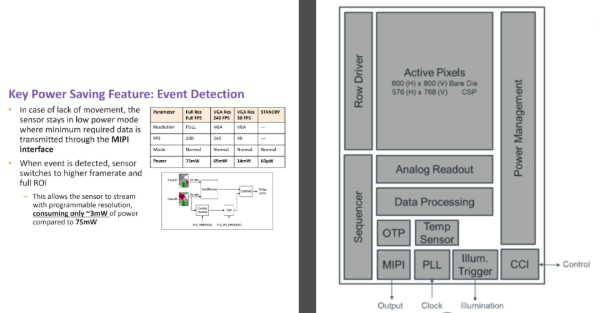
Mixel has customized its D-PHY TX+ solution, combining D-PHY v2.1 and CSI-2 v1.3 functionality into a single IP block. It boasts high-speed transmit and receive speeds of 1.5Gbps per channel. In low-power mode, transmit and receive speeds operate at 10Mbps. The 4-channel D-PHY TX+ IP module provides more data channels for even higher transmission rates. The D-PHY TX+ IP has been completely redesigned for superior efficiency. It uses 30% less area than comparable D-PHY configurations, yet provides 100% test coverage of its hard macroblock through its BIST functionality.
The Mira050 sensor features both "all-on" and "all-standby" modes. However, the Mira050 can optimize sensor resolution, sampling, and frame rate to settings between these two extremes, keeping the MIPI transmission rate correspondingly synchronized. In effect, the sensor can adapt to its conditions, using only sufficient power to detect motion frame by frame.
Event detection begins by tiling one or more regions of interest within the sensor's field of view. Uncompromising streaming performance up to 290 fps is delivered by coordinating the Mira050 sensor's resolution and sampling rate, frame rate, and MIPI transfer rate, and by rapidly switching between modes, while saving energy by reducing resolution and frame rate where appropriate. Mixel MIPI IP is an integral part of this solution, providing performance, power manageability, one-time silicon success, and production testability.
Summary:
The MIPI interface provides flexibility and scalability for achieving ultra-low power consumption in streaming sensors. By combining the low duty cycle sensor principle, the flexibility of the MIPI D-PHY and CSI-2 interface, and advanced image processing techniques, superior performance and power efficiency can be achieved.



