





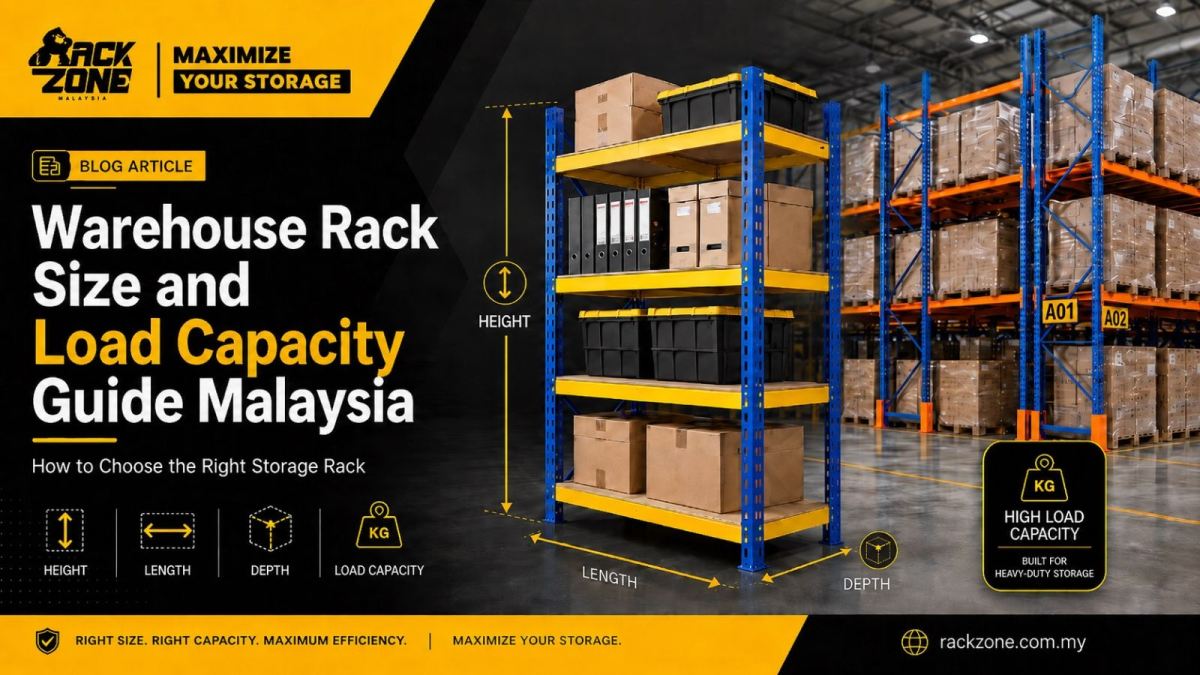
Choosing the correct warehouse rack is not only about finding a rack that fits your space. The rack must also be suitable for the size, weight and storage method of your products.
A rack that is too small may limit your storage capacity, while a rack with insufficient loading capacity may become unsafe. On the other hand, choosing an oversized or overly heavy duty system may increase your cost unnecessarily.
This guide explains how to choose the right warehouse rack size and load capacity for warehouses, shops, offices, storerooms and industrial facilities in Malaysia.
Why Rack Size and Load Capacity Matter
The correct racking system helps you:
-
Maximise available floor and vertical space
-
Improve stock organisation
-
Make products easier to access
-
Reduce unnecessary handling time
-
Create a safer storage environment
-
Avoid overloading or damaging the rack
-
Prepare for future business growth
Before purchasing a rack, you should understand the height, length, depth and loading capacity required for your operation.
1. Measure Your Available Storage Space
Start by measuring the actual area where the rack will be installed.
Important measurements include:
-
Ceiling height
-
Floor-to-beam clearance
-
Available wall length
-
Walkway and aisle width
-
Door and roller-shutter dimensions
-
Lift or staircase access
-
Location of columns, pipes, electrical panels and fire equipment
Do not use the entire room measurement as the rack size. You must leave sufficient space for movement, stock handling, doors, ventilation and daily operations.
For warehouses using forklifts or pallet jacks, proper aisle width is especially important.
2. Choose the Correct Rack Height
Using vertical space can significantly increase your storage capacity without expanding your building.
Common boltless rack heights include:
150 / 180 / 210 / 240 / 270 / 300 cmHigher rack options may also be available depending on the racking system.
When choosing the rack height, consider:
-
Ceiling height
-
The height of your products
-
How staff will access the upper levels
-
Whether ladders, pallet jacks or forklifts will be used
-
Fire-safety and building-clearance requirements
For offices, shops and storerooms, the products should remain easy and safe for staff to reach.
For warehouses, taller pallet racking can help maximise vertical space, but it must be designed according to the building height, pallet size and forklift reach.
3. Select the Right Rack Length
The rack length affects both storage capacity and load capacity.
Common boltless rack lengths include:
60 / 90 / 120 / 150 / 180 cmLonger shelves provide more storage space, but the loading capacity may reduce as the beam span becomes longer.
For example, a shorter rack level may support a heavier evenly distributed load than a longer rack level using the same beam design.
When selecting the length, consider:
-
Product dimensions
-
Number of cartons per level
-
Available wall length
-
Number of rack bays required
-
Weight distribution across the shelf
Do not choose the longest rack only for convenience. The rack length should match the actual products being stored.
4. Choose the Correct Rack Depth
The rack depth should be suitable for the size of your cartons, files, tools, containers or pallets.
Common boltless rack depths include:
30 / 45 / 60 cmDeeper rack options are available for long span and pallet racking systems.
Typical recommendations:
-
30 cm depth: documents, small boxes and light office storage
-
45 cm depth: retail stock, medium cartons and general storage
-
60 cm depth: larger cartons, tools, spare parts and heavier goods
-
90 cm or more: long span shelving, bulky items and palletised storage
A rack that is too shallow may cause products to overhang. A rack that is too deep may waste space and make items at the back difficult to reach.
5. Understand the Load Capacity Per Level
Load capacity refers to the maximum weight that each rack level can safely support.
The required load capacity depends on:
-
Total product weight per shelf
-
Number of cartons or items per level
-
Type of beam and upright
-
Shelf material
-
Rack length and depth
-
Whether the load is evenly distributed
Always calculate the total weight for one complete level.
For example:
If one carton weighs 20 kg and you plan to place 10 cartons on one level:
20 kg × 10 cartons = 200 kg per level
The selected rack should safely support at least 200 kg per level, with a suitable safety allowance.
6. What Does UDL Mean?
UDL stands for Uniformly Distributed Load.
It means the total weight must be spread evenly across the entire shelf.
For example, if a rack is rated for 400 kg per level under UDL conditions, the 400 kg must be distributed across the shelf rather than concentrated in one small area.
Placing one very heavy machine, safe or steel component in the centre of the shelf may create point loading, even when the total weight is below the stated UDL capacity.
Point loading can cause:
-
Shelf bending
-
Beam deformation
-
Uneven pressure
-
Rack instability
-
Premature damage
Customers storing machinery, moulds, engines or concentrated heavy items should inform the rack supplier before ordering.
7. Shelf Material Also Affects Your Storage System
The shelf material should match the storage environment and product type.
MDF Board
MDF is a practical and affordable option for general indoor storage.
Suitable for:
-
Cartons
-
Files
-
Dry goods
-
Office supplies
-
Light and medium storage
MDF should be kept away from excessive moisture and water.
Plywood
Plywood is stronger and more moisture-resistant than standard MDF, depending on its grade and construction.
Suitable for:
-
Workshops
-
Spare parts
-
Tools
-
General industrial storage
-
Areas requiring a stronger timber-based shelf
Metal Shelving
Metal shelves are durable, easy to clean and suitable for many commercial or industrial environments.
Suitable for:
-
Warehouses
-
Retail shops
-
Food-related storage areas
-
Workshops
-
Humid environments
-
Customers who prefer a longer-lasting shelf surface
The loading capacity depends on the complete rack structure, not only the shelf material.
8. Which Racking System Should You Choose?
Boltless Rack
Suitable for:
-
Homes
-
Offices
-
Retail shops
-
Storerooms
-
Small warehouses
-
Tools, cartons, files and loose items
Advantages:
-
Easy to assemble
-
Adjustable shelf levels
-
Cost-effective
-
Available in multiple sizes and colours
-
Suitable for manual stock picking
Long-Span Rack
Suitable for:
-
Medium to heavy cartons
-
Auto parts
-
Hardware
-
Industrial components
-
Bulky hand-loaded products
Advantages:
-
Wider beam spans
-
Higher loading capacity
-
Suitable for larger and heavier items
-
Flexible shelf configuration
Pallet Racking
Suitable for:
-
Warehouses
-
Factories
-
Distribution centres
-
Logistics operations
-
Palletised products
-
Forklift-access storage
Advantages:
-
High load capacity
-
Maximises warehouse height
-
Direct access to pallets
-
Suitable for forklift operations
-
Customisable according to pallet and warehouse dimensions
9. Common Mistakes When Choosing a Warehouse Rack
Choosing Based on Price Only
- The cheapest rack may not have the correct size, structure or loading capacity for your products.
- Guessing the Product Weight
- Customers often underestimate the total weight placed on each level. Always calculate the combined weight of all items.
- Ignoring the Rack Depth
- Products should sit properly within the shelf area without excessive overhang.
- Concentrating Heavy Loads in One Area
- A rack rated under UDL conditions may not be suitable for concentrated point loading.
- Using the Wrong Rack for Pallets
- Standard boltless racks are not designed for forklift-loaded pallets. Palletised storage normally requires a proper pallet-racking system.
- Not Planning for Future Growth
- Your storage needs may increase. A well-planned layout should allow for future extension where possible.
- Ignoring the Floor and Installation Area
- The rack should be installed on a stable and level floor. Uneven flooring may affect alignment and stability.
10. Information to Prepare Before Requesting a Quotation
To receive a more accurate recommendation, prepare the following details:
-
Rack height required
-
Rack length required
-
Rack depth required
-
Number of shelf levels
-
Maximum weight per level
-
Product or carton dimensions
-
Product weight
-
Quantity of racks required
-
Installation location
-
Ground-floor or upper-floor access
-
Lift or staircase availability
-
Site photos or floor plan
-
Whether forklift access is required
For pallet racking, you should also provide:
-
Pallet length, width and height
-
Maximum pallet weight
-
Number of pallets
-
Forklift model or reach height
-
Warehouse ceiling height
-
Desired aisle width
-
Building layout
Professional Rack Supply and Installation in Malaysia
Rack Zone Storage Sdn Bhd provides storage-racking solutions for warehouses, offices, retail shops, factories and commercial facilities.
Our product range includes:
-
Boltless rack
-
Heavy-duty rack
-
Long-span shelving
-
Pallet-racking systems
-
Warehouse rack
-
Shop rack
-
Office rack
-
Retail shelving
-
Mezzanine-platform systems
-
Customised storage solutions
We serve customers in Kuala Lumpur, Selangor, Klang Valley, Penang and throughout Malaysia.
Our team can recommend a suitable rack size, load capacity and layout based on your products, available space and operational requirements.
Need Help Choosing the Right Rack?
Send us the following information:
-
Storage-area dimensions
-
Product size
-
Product weight
-
Number of items or pallets
-
Preferred rack height, length and depth
-
Installation location
-
Photos of the site
Rack Zone will help you select a practical and cost-effective storage solution.
Rack Zone Storage Sdn Bhd
Racking Solutions to Maximise Your Storage





