


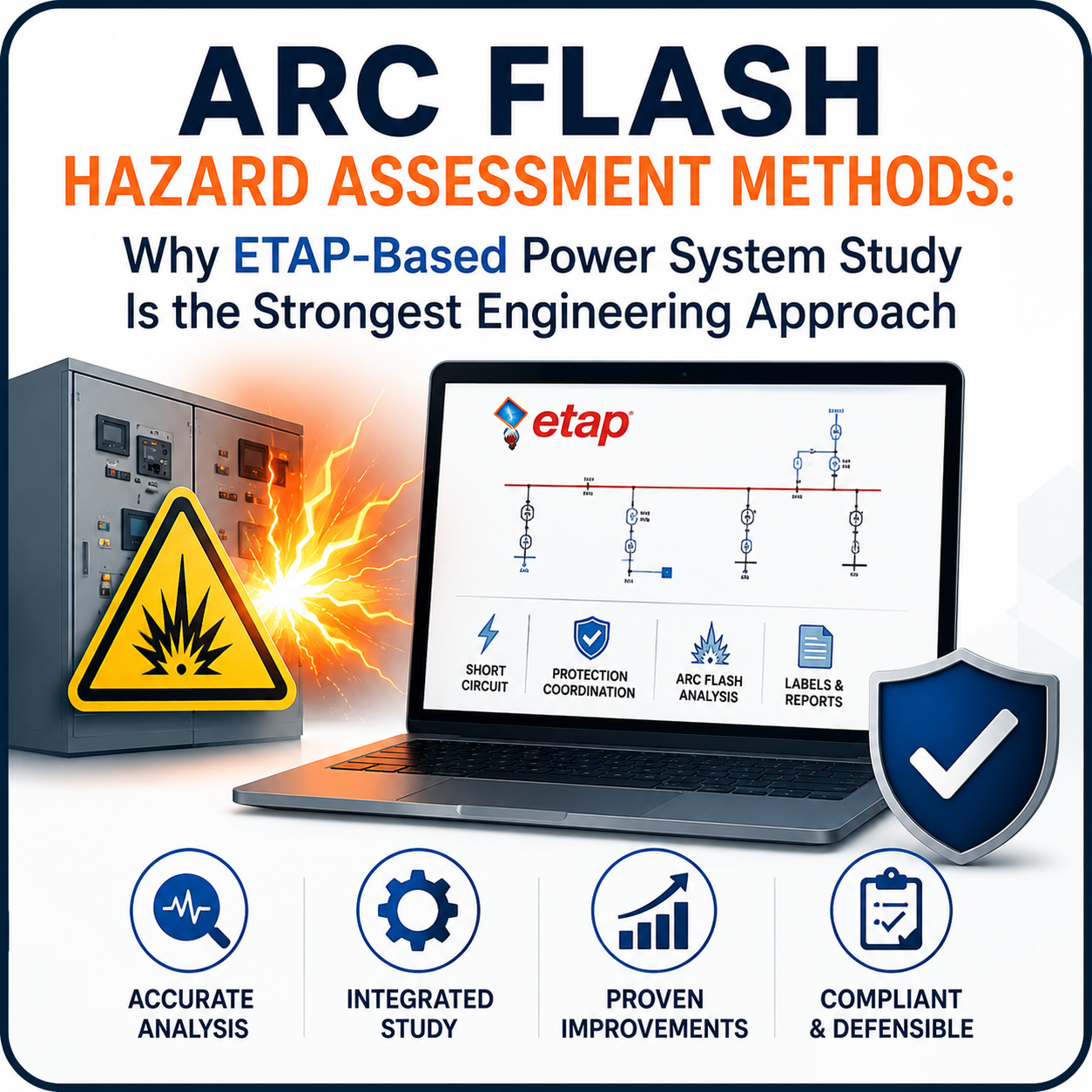
Arc Flash Study Methods: Why ETAP Gives the Strongest Engineering Case
Arc flash assessment should not stop at printing labels. A serious study must calculate the hazard, identify why it exists, model improvement options and prove how the risk can be reduced.
Arc flash incident energy is not a standalone number. It is driven by fault current, arcing current, protective device clearing time, system configuration and operating mode.
Many assessments fail because they treat arc flash as an isolated calculation. The result may look complete, but the study does not explain whether the hazard can be reduced through protection setting optimisation, maintenance mode, ZSI, differential protection or operating changes.
This is why the study method matters. A spreadsheet may calculate incident energy. ETAP helps engineers model the electrical system, test mitigation options and prove the before-and-after improvement.
The real objective is to understand the hazard, reduce exposure and produce a defensible engineering record that supports safety, compliance and maintenance planning.
What a Proper Arc Flash Study Must Answer
A complete Arc Flash Hazard Assessment should connect the electrical model, fault level, protective device clearing time and worker exposure. It should answer:
- What is the available fault current at each switchboard, MCC, panel or bus?
- Which device clears the arcing fault, and how long does it take?
- What is the incident energy and arc flash boundary?
- Which locations have high or unacceptable incident energy?
- Which engineering improvements can reduce the hazard?
- Can the improvement be proven before implementation?
Common Arc Flash Assessment Methods and Their Shortcomings
Rule-of-Thumb PPE Selection
Used for basic awareness or quick guidance, but not a site-specific engineering study.
- No actual fault current calculation
- No protective device clearing time review
- Cannot model mitigation
- High risk of over- or under-protection
Manual Calculation
Useful for theory and spot checks, but difficult for real industrial networks.
- Slow and error-prone for many buses
- Difficult to handle multiple sources
- Weak scenario management
- Not practical for large facilities
Spreadsheet Calculation
Common and flexible, but normally disconnected from the actual power system model.
- Manual data transfer risk
- Weak link to protection coordination
- Difficult to control revisions
- Limited before-and-after proof
Online Calculators
Useful for quick screening, but only as reliable as the values entered.
- No full single-line model
- No detailed relay or breaker curves
- No operating scenario study
- Not suitable for final labels
Why ETAP Is the Stronger Engineering Approach
ETAP places the arc flash study inside a complete power system model. The same single-line model can support load flow, short-circuit, protection coordination and arc flash analysis. This gives the engineer one connected environment to calculate the hazard and test how it can be reduced.
Standards and Compliance References
A proper ETAP-based Arc Flash Hazard Assessment can be aligned with internationally recognised standards and safety references, applied together with Malaysian owner requirements, competent person review and site HSE procedures.
Improvements That Can Be Modelled and Proven in ETAP
The strongest value of ETAP is not only identifying high incident energy. It allows the engineer to test mitigation options and prove the expected improvement before physical changes are made.
Long delay settings result in slower fault clearing and higher incident energy.
ETAP verifies faster clearing while checking coordination impact.
Normal settings prioritise selectivity but may increase exposure during maintenance.
ETAP compares normal mode against maintenance mode incident energy.
Short-time delays are used to maintain selectivity, increasing arc flash energy.
ZSI is modelled to reduce clearing time while retaining selectivity.
Old devices may have slow clearing, limited curves or poor adjustability.
Modern trip units or relays are modelled to prove incident energy reduction.
Bus-tie closed, generator operation or parallel transformers may increase fault level.
ETAP compares system configurations and identifies safer operating modes.
Fault clearing depends only on conventional overcurrent protection.
Fast protection schemes are modelled to demonstrate reduced exposure.
Method Comparison
| Method | Good For | Main Weakness | Mitigation Modelling | Engineering Confidence |
|---|---|---|---|---|
| Rule-of-thumb PPE | Basic awareness | Not site-specific | No | Low |
| Manual calculation | Spot checks | Not scalable | Very limited | Low to medium |
| Spreadsheet | Simple calculations | Manual data transfer risk | Limited | Medium |
| Online calculator | Quick screening | No network model | No | Low |
| Partial software | Limited-scope studies | Weak study integration | Depends on tool | Medium |
| ETAP integrated study | Industrial, commercial and utility systems | Requires accurate data and competent modelling | Yes | High |
Recommended ETAP Study Workflow
The workflow can be expanded with load flow, equipment duty review, relay setting optimisation, mitigation modelling and before-and-after comparison. This allows the final report to become an engineering improvement document, not only a compliance file.
Conclusion: Arc Flash Assessment Must Move Beyond Labels
Rule-of-thumb methods, manual calculations, spreadsheets and online calculators may support early review or spot checking. They are not the strongest method for complex electrical installations where protection coordination, operating modes and mitigation options must be evaluated.
ETAP provides the best engineering approach because it connects the arc flash calculation to the full power system model. It allows the engineer to calculate the hazard, test mitigation, compare scenarios and prove the improvement before implementation.
ETAP does not only calculate the arc flash hazard. It helps prove how the hazard can be reduced.