


-
An Introduction To Coursesinc
Category by 未分类 -
Is Your Training Creating Real Business Impact?
Organizations invest significant time and resources in employee training, yet many still struggle to answer a simple question: Has performance actually improved?
Traditional measures such as attendance records, training hours, and course completion rates provide useful information, but they do not tell the whole story. Business leaders are increasingly focused on outcomes that matter—higher productivity, improved quality, better customer satisfaction, and stronger employee performance.
In today's fast-changing workplace, learning can no longer be limited to occasional classroom sessions. Employees need access to knowledge, coaching, and skills development while they work. This approach, often called "learning in the flow of work," enables employees to learn, apply, and improve continuously without disrupting productivity.
At Coursesinc, we help organizations build future-ready workforces through practical training, AI-powered learning, leadership development, quality management programs, and continuous learning solutions. Our goal is simple: transform learning from a periodic event into a daily habit that delivers measurable business results.
The future of workplace learning is not about attending more training—it is about making learning part of work itself.
Category by AI Tools & Learning Hub -
How Managers Can Use ChatGPT Productively
The workplace is changing rapidly, and managers today are expected to do more than ever before. From handling meetings and reports to leading teams and making fast decisions, the pressure to stay productive is increasing across every industry.
This is where AI tools like ChatGPT can become a valuable workplace assistant.
Contrary to popular belief, ChatGPT is not about replacing managers. Instead, it helps managers work smarter by reducing repetitive tasks and allowing them to focus more on leadership, strategy, and people development.
For example, managers can use ChatGPT to draft professional emails, summarize meeting discussions, prepare reports, generate training ideas, or even brainstorm solutions during problem-solving sessions. Tasks that once took hours can now be completed much faster with proper AI support.
One of the biggest advantages is time efficiency. Many managers spend a large portion of their day handling administrative work. By using AI productively, they can reduce routine workload and focus more on coaching teams, improving productivity, and driving business growth.
However, AI should always be used responsibly. ChatGPT works best when combined with human judgment, experience, and critical thinking. Managers should avoid overdependence on AI and always review outputs carefully, especially when handling confidential or sensitive information.
The future workplace will increasingly involve collaboration between humans and AI. Managers who learn how to use tools like ChatGPT effectively may gain a strong advantage in communication, productivity, and decision-making.
In the end, productivity is no longer just about working harder. It is about working smarter, adapting faster, and learning continuously in an AI-driven world.
To learn more about AI workplace productivity and professional development, visit Coursesinc.com.
Category by AI Tools & Learning Hub -
Is Your Training Really Suitable for Your Staff?
A Reflection for HR & Learning & Development Professionals

Many organizations genuinely want to invest in their people.
Every year, HR and Learning & Development teams work hard to organize training programs, source trainers, manage budgets, coordinate schedules, and encourage employees to learn new skills. The intention is always positive — to help employees improve, grow, and contribute more effectively at work.
Yet after many training sessions, a familiar concern quietly remains:
“Why doesn’t performance seem to improve?”
This is not a criticism of HR or L&D teams. In reality, most organizations are trying their best in a rapidly changing world. Technology is evolving, industries are transforming, employee expectations are shifting, and new skills are emerging faster than ever before.
The challenge today is not whether organizations are conducting training.
The real challenge is whether the training is truly suitable for the people attending it.
This is where a simple but powerful concept called the “5 Why” can help organizations pause, reflect, and think more deeply.
Instead of accepting surface-level answers, the “5 Why” approach encourages us to keep asking “Why?” until we uncover the real root cause behind an issue.
And sometimes, the answers reveal something important.
Training Attendance Does Not Always Mean Learning
Imagine this situation:
An employee attends a training course. The organization spends time and money supporting the learning process. Everyone leaves the session feeling motivated and inspired.
But several months later, work performance remains the same.
Mistakes still happen. Productivity does not improve. Managers become frustrated. Employees themselves may feel discouraged.
The immediate reaction is often:
- “The training wasn’t effective.”
- “Employees are not applying what they learnt.”
- “Maybe they were not interested.”
But if we slow down and ask a deeper question:
Why did performance not improve?
We may discover:
Because the training was not closely related to the employee’s actual work challenges.
This realization is important.
Sometimes employees attend training that sounds impressive but does not truly connect with the realities they face every day at work.
When training feels disconnected from daily responsibilities, employees may struggle to apply what they learnt — not because they are unwilling, but because the learning does not fully fit their environment.
Are We Choosing Training Based on Needs — or Habit?
Many organizations unintentionally select training reactively.
Sometimes training decisions are influenced by:
- Available budgets
- Trending topics
- Vendor recommendations
- Annual calendars
- Compliance requirements
- Last year’s programs
There is nothing wrong with these considerations. However, if organizations do not first understand what employees actually need, even good training programs may fail to create meaningful impact.
This leads to another important question:
Why was the training not relevant?
The answer may be:
Because the organization did not properly identify the real training needs.
This is where HR and L&D professionals have an opportunity to lead more strategically.
Employees today are facing increasing pressures:
- AI and automation
- Digital transformation
- Higher customer expectations
- Faster work environments
- Constant change
Many employees themselves may not even know what skills they are lacking until they encounter difficulties at work.
Training should therefore not only focus on delivering information.
It should help employees solve real problems, build confidence, and prepare for the future.
Employees Want to Grow — But They Need Guidance
Most employees genuinely want to perform well.
They want to contribute.
They want to improve.
They want to feel valuable.But growth becomes difficult when organizations do not clearly understand the gaps between:
- Current skills
- Future expectations
- Business needs
- Employee capability
This is why skills gap assessments are becoming increasingly important.
Without assessing capabilities, organizations may unknowingly:
- Send the wrong employees for training
- Organize courses that are too basic or too advanced
- Overlook critical future skills
- Miss opportunities to build stronger teams
The workplace today requires far more than technical knowledge alone.
Employees are now expected to demonstrate:
- Adaptability
- Communication
- Critical thinking
- Problem-solving
- AI awareness
- Collaboration
- Emotional intelligence
Training can no longer be a one-size-fits-all activity.
Employees are human beings with different learning needs, experiences, and challenges.
Learning Must Connect to Real Work
One of the biggest frustrations employees experience after training is this:
“I attended the course, but I still don’t know how to apply it in my job.”
This is not always because the employee failed to learn.
Sometimes the workplace itself does not support the learning process.
Managers may not reinforce the new skills.
Work routines may remain unchanged.
Employees may return to old habits simply because there is no opportunity to practice differently.This reminds organizations of an important truth:
Training alone does not create transformation.
Real learning happens when:
- Managers support development
- Leaders encourage application
- Employees feel safe trying new approaches
- Learning becomes part of daily work culture
Employees should not feel that training is just another “HR requirement.”
They should feel that the organization is genuinely investing in their future.
HR & L&D Have a Bigger Role Than Ever Before
The role of HR and Learning & Development is changing rapidly.
Today, HR professionals are no longer only administrators of training programs.
They are becoming:
- Workforce strategists
- Talent developers
- Capability builders
- Culture shapers
- Future-readiness partners
This requires a shift in mindset.
Instead of only asking:
“What training should we organize this year?”
Organizations should begin asking:
- What challenges are employees struggling with?
- What skills will be needed in the future?
- What capabilities are missing today?
- How can we help employees feel more confident and prepared?
- How can learning become continuous rather than occasional?
These questions create deeper and more meaningful workforce development strategies.
The Future of Training Is Human-Centered
In today’s world, employees are not just looking for courses.
They are looking for:
- Growth
- Purpose
- Confidence
- Relevance
- Support
- Opportunities to succeed
The organizations that thrive in the future will not necessarily be the ones conducting the most training.
They will be the organizations that truly understand their people.
Training should not simply fill calendars.
It should:
- Solve real problems
- Build practical capability
- Strengthen confidence
- Improve collaboration
- Prepare employees for change
- Help people grow professionally and personally
Because when employees feel that learning genuinely helps them become better at what they do, engagement naturally increases.
And when learning becomes meaningful, organizations become stronger from within.
A Final Thought for HR & L&D Leaders
Perhaps the most important reflection is this:
Employees do not want training for the sake of training.
They want learning that matters.
Learning that helps them perform better.
Learning that reduces uncertainty.
Learning that prepares them for the future.
Learning that shows the organization believes in their potential.The “5 Why” approach reminds us that ineffective training is rarely caused by a single issue.
Very often, it is an invitation for organizations to think more deeply about:
- People
- Purpose
- Capability
- Leadership
- Culture
- Future readiness
And maybe the question is no longer:
“Did we conduct training?”
But instead:
#LearningAndDevelopment“Did we truly help our people grow?”
#FutureSkills
#FutureOfWork
#Upskilling
#Reskilling
#ContinuousLearning
Category by Training in 5-Why -
ISO TIPS
Category by ISO Certification -
AI in the Workplace: Why Human Skills Matter More Than Ever
.png)
Artificial Intelligence (AI) is no longer a futuristic concept found only in science fiction movies. Today, AI is transforming workplaces across industries — from manufacturing and healthcare to banking, education, logistics, customer service, and corporate management. Businesses around the world are rapidly adopting AI technologies to improve productivity, automate repetitive tasks, enhance decision-making, and remain competitive in an increasingly digital economy.However, while AI continues to evolve, one important reality remains unchanged: people still matter.
The future workplace will not belong solely to machines. Instead, it will belong to professionals who can combine human intelligence, creativity, emotional understanding, and communication skills with AI-powered tools. Organizations that successfully integrate AI into their operations while developing their workforce capabilities will gain a significant advantage in the years ahead.
AI Is Changing the Nature of Work
Across many industries, employees are already experiencing the impact of AI in their daily work. Tasks that once required hours of manual effort can now be completed within minutes using AI-assisted platforms.
Examples include:
- AI chatbots handling customer inquiries
- Automated report generation
- Predictive analytics for business decisions
- AI-powered marketing campaigns
- Smart manufacturing systems
- Recruitment screening tools
- AI-generated presentations and content
- Workflow automation in offices
Tools such as ChatGPT, Google Gemini, Microsoft Copilot, and other generative AI platforms are helping organizations improve efficiency and productivity. Employees are increasingly expected to understand how these technologies work and how to use them effectively.
This shift is creating strong demand for professionals with practical AI knowledge and workplace-ready digital skills.
As a result, companies are investing heavily in AI Skills Training to prepare employees for the future of work.
AI Will Not Replace Everyone — But It Will Change Everyone’s Job
One of the biggest fears surrounding AI is job displacement. While automation may replace certain repetitive tasks, AI is more likely to reshape jobs rather than eliminate them entirely.
In reality, AI works best when combined with human capabilities.
For example:
- AI can generate data, but humans interpret meaning.
- AI can automate processes, but humans manage relationships.
- AI can draft content, but humans provide judgment and creativity.
- AI can suggest solutions, but humans make ethical decisions.
This means employees who learn how to work alongside AI will become more valuable in the workplace.
Professionals who resist digital transformation may struggle to remain competitive, while those who embrace continuous learning will discover new opportunities for growth and career advancement.
This is why organizations across Southeast Asia are increasingly exploring AI Training Singapore programs to equip employees with future-ready competencies.
The Growing Importance of AI Literacy
AI literacy is quickly becoming as important as computer literacy was decades ago.
Employees do not necessarily need to become software engineers or data scientists to benefit from AI. Instead, they need to understand:
- What AI can and cannot do
- How to use AI tools responsibly
- How to improve productivity using AI
- Ethical and security considerations
- AI-assisted communication and reporting
- Prompt engineering techniques
- AI collaboration in teams
Workers who possess these skills are better positioned to adapt to changing business environments.
Many companies are now introducing internal AI awareness programs and practical workshops to build employee confidence in using AI tools. These initiatives are helping organizations reduce resistance to technology adoption while improving workplace efficiency.
The rise of ChatGPT Training programs is a clear example of how businesses are prioritizing practical AI education for their teams.
AI and Human Skills Must Work Together
While technical AI knowledge is important, human-centered skills remain equally critical.
In fact, as AI handles more technical and repetitive work, uniquely human skills become even more valuable.
These include:
- Leadership
- Communication
- Emotional intelligence
- Critical thinking
- Creativity
- Problem-solving
- Adaptability
- Team collaboration
Organizations increasingly recognize that AI should support employees rather than replace them.
A successful AI-driven workplace is not one where humans become less important. Instead, it is one where employees can focus on higher-value tasks while AI assists with routine activities.
For example, managers can spend more time coaching employees instead of preparing repetitive reports. Sales professionals can focus on relationship-building while AI handles administrative work. Trainers can create more engaging learning experiences with AI-assisted content development.
This balanced approach allows businesses to improve efficiency without losing the human connection that drives innovation and trust.
Why Businesses Must Invest in AI Training
One major challenge many organizations face today is the AI skills gap.
While AI technology continues to advance rapidly, many employees lack the confidence or knowledge to use these tools effectively. Without proper training, businesses may struggle to maximize the value of AI investments.
This is why structured training programs are becoming essential.
Companies that invest in AI education can benefit from:
- Increased employee productivity
- Faster digital transformation
- Improved innovation
- Better decision-making
- Enhanced customer engagement
- Reduced operational inefficiencies
- Stronger workforce adaptability
Businesses in Singapore and Malaysia are increasingly seeking practical and industry-focused learning solutions to prepare their workforce for future demands.
As demand grows, professional development providers are expanding offerings related to AI Courses Malaysia and regional workplace AI capability programs.
The Role of Leadership in AI Adoption
Successful AI transformation requires strong leadership commitment.
Leaders play a crucial role in shaping organizational attitudes toward AI. Employees are more likely to embrace new technologies when leadership communicates clear goals, provides proper support, and encourages continuous learning.
Organizations should avoid creating a culture of fear around AI. Instead, leaders should position AI as a productivity tool that empowers employees.
Key leadership priorities include:
- Encouraging lifelong learning
- Supporting workforce reskilling
- Promoting ethical AI usage
- Creating open communication
- Providing practical AI exposure
- Building digital confidence
When employees feel supported during periods of technological change, organizations are more likely to achieve successful adoption outcomes.
AI in Southeast Asia’s Future Workforce
Southeast Asia is entering a major period of digital transformation.
Countries such as Singapore and Malaysia are investing heavily in AI innovation, digital economy initiatives, smart manufacturing, and future workforce development.
Businesses that prepare early will gain a stronger competitive advantage in this evolving environment.
Industries expected to see significant AI integration include:
- Manufacturing
- Healthcare
- Finance
- Education
- Logistics
- Customer service
- Human resources
- Marketing
- Professional services
As AI adoption accelerates, the demand for digitally skilled professionals will continue to rise.
Employees who develop AI capabilities today are positioning themselves for long-term career resilience.
Conclusion
AI is reshaping the workplace at an unprecedented pace. While technology will continue to evolve, human adaptability, communication, creativity, and leadership remain essential for organizational success.
The future workplace will not simply be about artificial intelligence. It will be about how humans and AI collaborate together to create smarter, more productive, and more innovative organizations.
Businesses that invest in workforce development today will be better prepared for tomorrow’s challenges.
Likewise, employees who embrace continuous learning and develop practical AI capabilities will remain valuable contributors in the modern digital economy.
As organizations across the region continue to prioritize digital transformation, programs related to AI Training Singapore, AI Courses Malaysia, AI Skills Training, and ChatGPT Training are expected to play an increasingly important role in shaping the workforce of the future.
Category by AI Tools & Learning Hub -
Continuous Improvement
Continuous improvement is one of the most important success factors for organizations that want to remain competitive in today’s fast-changing business environment. Whether in manufacturing, services, education, healthcare, or technology industries, businesses that continuously improve their processes, people, and systems are better positioned for long-term growth and customer satisfaction.
Here are some practical continuous improvement tips for organizations:
1. Build a Continuous Improvement Culture
Improvement should not only come from management. Encourage employees at all levels to share ideas, identify problems, and participate in process improvements. Small improvements made consistently can create major long-term results.
2. Focus on Data and Facts
Use accurate data to identify trends, defects, customer complaints, and operational weaknesses. Data-driven decisions help organizations solve problems more effectively and reduce assumptions.
3. Encourage Problem-Solving Mindsets
Train employees to identify root causes instead of only fixing symptoms. Tools such as 5 Why Analysis, Fishbone Diagram, and PDCA (Plan-Do-Check-Act) can support systematic problem solving.
4. Improve Communication and Teamwork
Strong communication between departments helps reduce misunderstandings, delays, and operational inefficiencies. Collaboration often leads to faster and more effective improvements.
5. Use Technology and AI Wisely
Modern AI tools can help organizations automate repetitive tasks, analyze large datasets, monitor quality trends, and improve decision-making. However, technology should support — not replace — human judgement and process discipline.
6. Conduct Regular Training
Employees who continuously upgrade their knowledge and skills are more adaptable and capable of supporting organizational improvement initiatives.
7. Learn from Audits and Customer Feedback
Internal audits, external audits, and customer feedback provide valuable opportunities to identify improvement areas and strengthen business performance.
8. Celebrate Improvement Successes
Recognizing employee contributions and improvement achievements helps motivate teams and strengthen a positive improvement culture.
Continuous improvement is not a one-time project — it is an ongoing journey. Organizations that consistently improve their processes, people, and systems will be more resilient, efficient, and prepared for future business challenges.
Category by AI Tools & Learning Hub -
AI in Quality Management — The Future of Business Excellence
Artificial Intelligence (AI) is rapidly transforming the world of quality management. Organizations are increasingly using AI technologies to improve operational efficiency, reduce defects, strengthen risk management, and support better decision-making. In industries guided by standards such as ISO 9001 and IATF 16949, AI is becoming a valuable tool for enhancing process control and continual improvement.
AI-powered systems can now assist businesses through automated inspections, predictive maintenance, quality trend analysis, document review, and real-time monitoring of production processes. These technologies help organizations move from reactive problem-solving to predictive quality management, allowing issues to be detected earlier before they become major operational risks.
However, while AI creates significant opportunities, businesses must also manage challenges such as data accuracy, cybersecurity, ethical AI usage, and human oversight. This is why strong quality management systems remain highly important in the digital era. The future of quality management will likely combine AI technology, risk-based thinking, cybersecurity awareness, and responsible governance frameworks such as ISO/IEC 42001.
Organizations that successfully integrate AI with structured quality management systems will be better positioned for long-term growth, operational excellence, and customer confidence in an increasingly competitive global marketplace.
Category by AI Tools & Learning Hub -
Effective Communication / 有效沟通 / komunikasi yang berkesan
-
Leading smarter in the AI era
Category by AI Tools & Learning Hub -
Series 1 Understand AI basics and how ChatGPT works
Category by AI Tools & Learning Hub -
Career Skills That Will Survive the AI Era
Category by AI Tools & Learning Hub -
How to use Gamma ai
How to Use Gamma AI – The Future of AI-Powered Presentations
Artificial Intelligence is transforming the way people create presentations, documents, and websites, and one of the fastest-growing tools in this space is. Instead of spending hours designing slides manually,
Gamma AI allows users to generate professional-looking presentations simply by typing a short prompt or idea. The platform automatically creates layouts, visuals, themes, and structured content, making it ideal for trainers, educators, consultants, marketers, students, and business professionals. Whether you are preparing a corporate proposal, training material, or marketing presentation, Gamma AI helps save time while producing visually engaging results.At Coursesinc, we believe AI knowledge will become an essential skill for the future workplace.
Category by AI Tools & Learning Hub
Our AI learning content aims to help beginners and professionals understand practical AI applications that can improve productivity, creativity, and communication. Through step-by-step guides and easy-to-follow examples, learners can discover how tools like Gamma AI can support business presentations, online learning, and digital content creation. Stay connected with Coursesinc as we continue to introduce more AI tools, tutorials, and modern workplace technologies designed to support continuous learning and innovation. -
Quality Management for Automotive Industry
Quality Management for Automotive Industry
The automotive industry is entering a new era where quality management is no longer limited to inspections and corrective actions. Manufacturers and suppliers are now expected to demonstrate strong risk management, process consistency, supplier control, and continuous improvement across the entire supply chain.
Standards such as ISO 9001 and IATF 16949 have become essential frameworks for organizations seeking to improve operational excellence, reduce defects, enhance customer confidence, and remain competitive in the global automotive market. With the rise of electric vehicles (EVs), smart manufacturing, AI-driven production, and stricter customer expectations, companies that invest in quality systems are positioning themselves for long-term sustainability and growth.At Coursesinc, our ISO 9001 and IATF 16949 training programmes are designed to help engineers, supervisors, quality professionals, and management teams build practical competency in automotive quality management systems. Participants will gain valuable knowledge in process-based auditing, risk-based thinking,
Category by QMS
Core Tools integration (APQP, FMEA, SPC, MSA, PPAP), and effective quality improvement strategies aligned with industry expectations. Whether your organization is preparing for certification, upgrading internal competencies, or strengthening supplier quality management, Coursesinc provides practical, industry-relevant training to support your transformation journey toward world-class automotive quality standards. -
Business Automation With AI
Artificial Intelligence (AI) is transforming the way professionals create presentations, making it faster, smarter, and more engaging than ever before.
Modern AI-powered applications can now generate PowerPoint slides, suggest professional designs, summarize information, create visuals, and even prepare presentation content from simple text commands.
Businesses, trainers, educators, and corporate teams are increasingly adopting these technologies to improve productivity and reduce the time required to prepare impactful presentations. With just a few prompts, users can create polished presentation decks that once required hours of manual work.At Coursesinc, we recognize the growing importance of AI in the modern workplace and training environment.
Category by AI Tools & Learning Hub
Our AI awareness and productivity programmes help participants understand how AI tools can enhance daily business operations, communication, reporting, and presentation development. Through practical demonstrations and hands-on learning, participants will discover how to use AI applications effectively while understanding both their benefits and limitations.
As AI continues to shape the future of work, organizations that embrace these technologies will gain a significant advantage in efficiency, creativity, and innovation. -
Corporate Training Courses in Singapore for Employees
Corporate Training Courses in Singapore for EmployeesUpskilling the Modern Workforce with Coursesinc
In today’s rapidly evolving business landscape, organizations in Singapore are investing heavily in employee development to remain competitive, resilient, and future-ready. From leadership and communication to AI, quality management, and workplace productivity, corporate training has become a strategic priority rather than just an HR function.
At Coursesinc, companies can access industry-relevant corporate training courses in Singapore designed to help employees strengthen professional competencies, improve performance, and support long-term organizational growth.
Why Corporate Training Matters in Singapore
Singapore’s workforce transformation initiatives, digital economy push, and increasing global competition have accelerated the demand for practical, results-driven employee training programs. Organizations are now focusing on:
- Leadership and people management skills
- Communication and workplace collaboration
- Artificial Intelligence (AI) and digital transformation
- Quality management and ISO standards
- Problem-solving and critical thinking
- Customer service excellence
- Workplace productivity and innovation
- Compliance and operational excellence
Companies that continuously upskill their employees are better positioned to improve productivity, employee retention, customer satisfaction, and overall business performance.
Coursesinc Corporate Training Solutions
Coursesinc offers a wide range of corporate training courses in Singapore tailored for professionals, executives, engineers, supervisors, HR teams, and business leaders across multiple industries.
The training approach emphasizes:
- Practical learning applications
- Interactive workshops and role-play sessions
- Real-world case studies
- Industry-relevant frameworks
- Customized corporate learning pathways
- Engaging trainer-led delivery
Whether organizations require in-house training, hotel-based workshops, or customized corporate learning solutions, Coursesinc supports businesses in developing workforce capabilities aligned with operational and strategic objectives.
Popular Corporate Training Courses for Employees
Leadership & Management Training
Strong leadership is essential in managing teams, driving innovation, and navigating business challenges. Leadership training courses help managers and supervisors improve:
- Team leadership
- Decision-making
- Conflict resolution
- Employee motivation
- Strategic thinking
Communication Skills Training
Effective communication remains one of the most important workplace skills. Coursesinc provides training that helps employees:
- Improve professional communication
- Build presentation confidence
- Enhance workplace collaboration
- Handle difficult conversations professionally
- Develop customer-facing communication skills
Artificial Intelligence (AI) at Work
As AI adoption accelerates across industries, employees need practical understanding of how AI tools can improve efficiency and productivity. AI training programs cover:
- AI fundamentals for business
- Generative AI applications
- AI productivity tools
- Workplace automation
- Responsible AI practices
Quality Management & ISO Training
For manufacturing and operational industries, Coursesinc also provides specialized quality and compliance training such as:
- ISO 9001 Quality Management Systems
- IATF 16949 Automotive Quality Management
- Core Tools Training (APQP, FMEA, SPC, MSA, PPAP)
- Supplier Quality Management
- Internal Auditor Training
These programs help organizations improve quality standards, compliance, and operational performance.
Customized Corporate Training for Organizations
One of the key advantages of working with Coursesinc is the ability to customize training programs according to business objectives, workforce challenges, and industry needs.
Customized corporate training can include:
- Company-specific case studies
- Industry-focused simulations
- Role-playing activities
- Team-based workshops
- Skills gap analysis
- Multi-location training deployment
This flexibility ensures training remains highly relevant and immediately applicable within the workplace.
Benefits of Employee Training and Development
Investing in employee training provides measurable business benefits, including:
- Increased employee engagement
- Higher productivity levels
- Improved staff retention
- Enhanced leadership capability
- Better customer experience
- Reduced operational errors
- Stronger organizational culture
- Future-ready workforce development
In Singapore’s competitive economy, continuous learning is no longer optional—it is a key driver of business sustainability and growth.
Looking for Corporate Training Courses in Singapore?
Organizations seeking practical, impactful, and professional corporate training courses for employees can explore the wide range of programs available at Coursesinc.
From leadership development and communication skills to AI transformation and quality management systems, Coursesinc helps companies build stronger, smarter, and more capable teams for the future.
Category by AI Tools & Learning Hub -
ISO 90012026 The Future of Quality Management Systems
Category by QMS -
Why Everyone Is Suddenly Talking About AI
Category by AI Tools & Learning Hub -
Root Cause Analysis
Category by QMS -
The Employee Gap
Category by AI Tools & Learning Hub -
Supplier Quality Management & Audit
Relationship between Supplier Quality Management & Audit to ISO 9001 & IATF 16949
Supplier Quality Management (SQM) & Supplier Quality Audit (SQA) is directly connected to both IATF 16949 & ISO 9001 because both standards require organizations to establish effective control, monitoring, evaluation and development of their suppliers.
Relationship with ISO 9001
ISO 9001 is the global foundation for Quality Management System (QMS). One of its key principles is ensuring that externally provided products, services and processes consistently meet customer and regulatory requirements.
Under ISO 9001, organizations are expected to:
- Evaluate and select suppliers based on their capability
- Monitor supplier performance continuously
- Conduct supplier audits when necessary
- Maintain approved supplier lists
- Control outsourced processes
- Address supplier non-conformities and corrective actions
- Ensure traceability and documented information
In simple terms, SQM is the operational process used to fulfill ISO 9001 supplier control requirements.
Without proper SQM, a company may fail ISO 9001 audits because poor supplier control can lead to:
- Product defects
- Delivery failures
- Customer complaints
- Regulatory non-compliance
Relationship with IATF 16949
IATF 16949 is built in ISO 9001 but adds much stricter automotive industry requirements.
In the automotive sector, SQM becomes far more critical because:
- Automotive supply chains are highly interconnected
- A single defective component can cause recalls or safety risks
- OEM customers demand zero-defect performance
IATF 16949 places emphasis on:
- Supplier Development
- Supplier Risk Management
- Second-party audits
- Supplier scorecards and KPI monitoring
- PPAP (Production Part Approval Process)
- APQP (Advanced Product Quality Planning)
- Supplier Corrective Actions (SCAR)
- Traceability and Change Management
- Continuous Supplier Performance Improvement
Supplier audits under IATF 16949 are therefore more structured, technical and Risk-Based compared to standard ISO 9001 audits.
How Supplier Audits Both Standards
SQA help organizations:
- Verify Supplier compliance
- Reduce Quality risks
- Improve supplier consistency
- Ensure customer requirements are met
- Identify process weakness early
- Strengthen supply chain resilience
Today, many companies are evolving from periodic supplier audits towards:
- Real time supplier monitoring
- AI-driven Risk prediction
- ESG compliance tracking
- Digital Supplier Dashboards
- Supplier Quality 4.0 systems
These modern appraches strongly support the risk-based thinking nd continuous improvement requirements found in both ISO9001 ans IATF 16949.

Conclusion
SQM & SQA acts as a core operational pillar supporting both:
- ISO 9001 for general Quality Management compliance and
- IATF 16949 for advanced automotive supply chain Quality Assurance
As industries move toward AI-driven Quality Systems and digital supply chains, SQM is becoming one of the most strategic functions for achieving certification success, customer confidence and long-term operational resilience.
Category by Supplier Quality -
ISO9001 QMS Consultancy
Category by Consultancy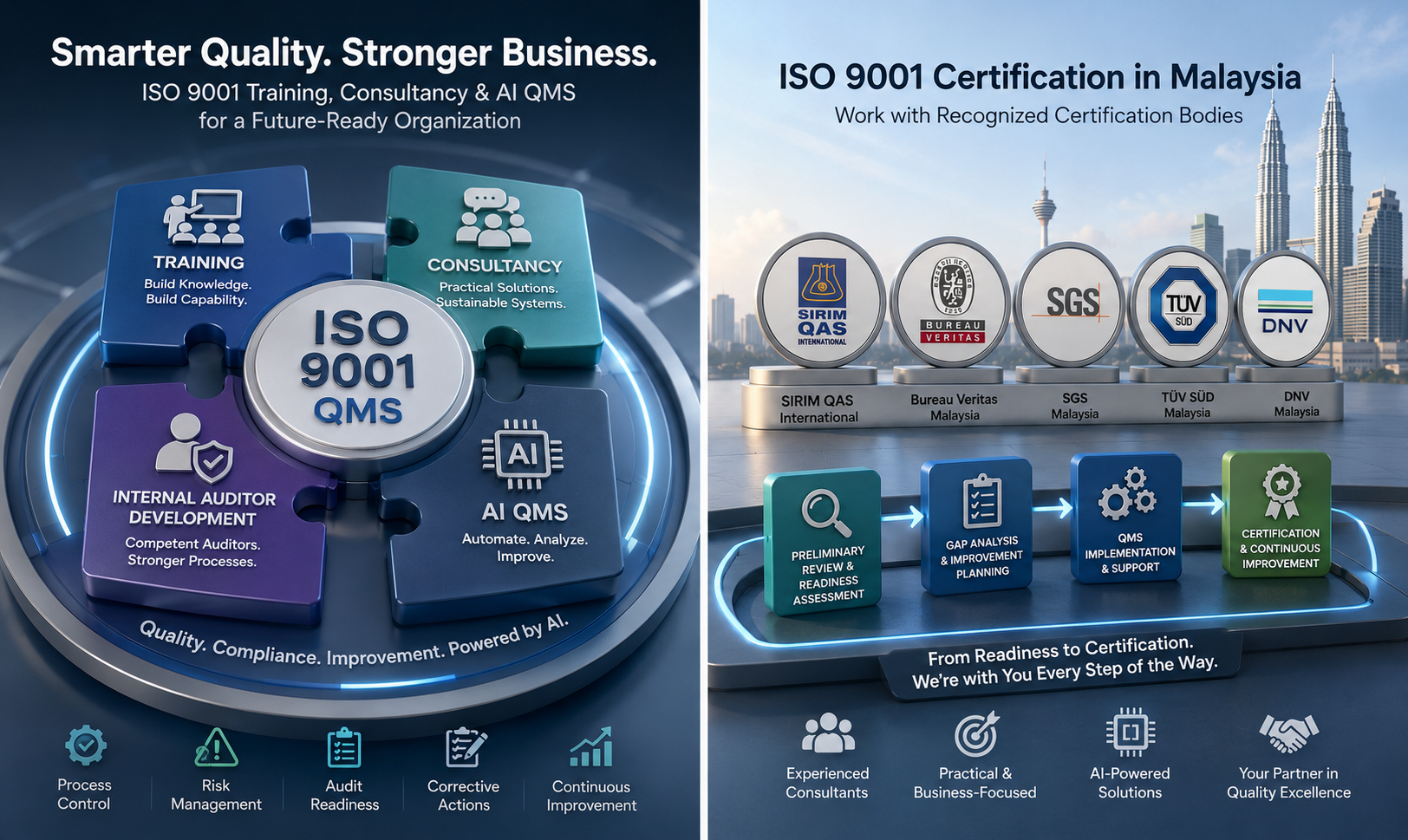
As industries accelerate digital transformation in 2026, more companies in Singapore & Malaysia are strengthening their focus on ISO9001 (QMS) Quality Management Systems, tro improve efficiency, customer satisfaction and regulatory compliance.
Businesses are now moving beyond traditional documentation methods and exploring AI-powered QMS solutions to automate workflows, improve audit readiness, analyze risks and enhance decision making. The integration of Artificial Intelligence (AI) into Quality Management is rapidly becoming a competitive advantage for forward looking organizations.
In Singapore and Malaysia organizations seeking ISO 9001 certification commonly work with internationally recognized certification bodies for certification & auditing services.
Before any consultancy engagement begins, Coursesinc also provides a preliminary review and readiness assessment to help organizations evaluate their current Quality Management capabilities and identify improvement opportunities. Should organizations require certification audit support, Coursesinc can also coordinate
In response to this growing demand, Coursesinc continues to expand its offerings in ISO 9001 Training, Consultancy, Internal Auditor Development, and AI-Enabled QMS Solutions. Coursesinc supports organizations in building practical, business-focused quality systems while helping teams understand how AI can enhance process control, reporting, corrective actions, and continuous improvement initiatives.
Before any consultancy engagement begins, Coursesinc also provides a preliminary review and readiness assessment to help organizations evaluate their current Quality Management capabilities and identify improvement opportunities. Should organizations require certification audit support, Coursesinc can also coordinate and include certifications preparation assistance as part of the consultancy package, helping companies strengthen their readiness and improve the likelihood of successfully passing the certification audit.
As AI & Quality Managemenbt increasingly converge, organizations that embrace smart QMS practices are expected to achieve stronger resilience, productivity and customer confidence in the years ahead. -
The Illusion of AI Taking Over Jobs
Every few weeks, headlines appear claiming that AI is replacing workers and eliminating jobs.
But the reality is more conmpex.
Many large-scale layoffs are not driven purely by AI. They are also about business restructuring, cost control and signalling confidence to inbvestors. When companies announce workforce reductions, markets often interpret it as a move toward greater efficiency and future readiness.
AI is part of the story - but not the entire story.
Jobs are Changing, not Disppearing
The world is not running out of jobs. Instead the demand for skills is evolving.
AI is highly effective at:
- Writing code
- Generating reports
- Automating repetitive tasks
- Supporting documentation and analysis
This means roles focussed only on repetitive execution are becoming more vulnerable.
The Real Risk
The biggest risk is not "working in tech". The risk is remaining in outdated work models where value is based only on task comnpletion without critical thinking, creativity, communication or business understanding.
The Future Belongs to Human-AI Collaboration
Organisations still need people who can:
- Solve Problems
- Think Strategically
- Communicate Effectively
- Understand Customers
- Lead Teams
AI can generate information but humans provide judgement, context, leadership and innovation.
Category by AI Tools & Learning Hub -
China's Linkerbot aims for billion valuation
Linkerbot's core purpose is to enable is to enable robots to perform human-level tasks in the real world.
Why focus on robotic hands?
- Hands are the final bottleneck in robotics:
1. Robots already have:
- vision (cameras & AI)
- Movement (arms, mobility)
2. But without dexterous hands - they cannot do most human work.
- So Linkerbot focuses on hands because:
3. That is where real productivity happens
4. It unlocks:
- Assembly work
- Electronics Manufacturing
- Logistics handling
- Service tasks
Category by AI Tools & Learning Hub -
How Does Ai works?
This animated video describes how artificial intelligence works, where it can be found, and how it influences our lives.
Category by AI Tools & Learning Hub -
What is GD&T?
In the world of Engineering & manufacturing, precision is not just a goal - its a requirement. Companies are designing smaller, smarter and more complex products and even the slightest misintepretation of a drawing can lead to costly delays, rework and scrap.
This is where GD&T becomes essential.
Once considered a niche technical skill, GD&T has now evolved into a universal engineering language for communicating design intent, ensuring product quality and reducing ambiguity across the entire production chain. And as industries push for higher accuracy and global standadisation, GD&T expertise is no longer optional - its a competitive advantage.
What Makes GD&T so important?
Whether you are designing aerospace components, automotive parts, consumer electronics or industrial machinery GD&T helps teams:
- Reduce errors and miscommunication across design, production and inspection.
- Improve manufacturing quality through precise tolerance control
- Minimise rework, defects and scrap, saving time and cost.
- Communicate design intent with clarity and consistency.
- Work seamlessly with global suppliers through ASME/ISO-compliant drawings.
In short: GD&T ensures thatb the part you design is the part that gets manufactured.
(1).png)
Category by GD&T
请登录后使用此功能。
您可以使用此功能将商品添加到您的收藏列表。
关闭
从您收藏列表中删除此商品。
关闭
请登录后使用此功能。
您可以使用此功能将公司添加到您的收藏夹列表。
关闭
这家公司已从你的收藏夹列表中删除。
关闭
请登录后使用此功能。
您可以使用此功能将公司添加到您的询问车。
关闭
这家公司已被添加到您的询问车。
关闭
这家公司已从询价车中删除。
关闭
该商品已被添加到您的询问车。
关闭
该商品已经从您的询价车中删除。
关闭
商品/公司已达到添加至询价车的数量。
关闭
Scan and Whatsapp Me
![qr code]() Note: Some mobile phone default QR scanners cannot scan to open the WhatsApp App directly.
Cancel
Note: Some mobile phone default QR scanners cannot scan to open the WhatsApp App directly.
Cancel


商业性质:
相关分类:
视频 - Coursesinc Pte Ltd
视频
总办事处
Coursesinc Pte Ltd 202340546C
60, Paya Lebar Road, #06-28, Paya Lebar Square, Singapore 409051.
电话:
邮件:
网址: https://www.coursesinc.com
网址: https://coursesinc.newpages.com.my/
网址: https://coursesinc.onesync.my/
其他办事处
JB Branch
29-02, Jalan Aliff 6, Taman Damansara Aliff, 81200 Johor Bahru, Johor, Malaysia.
手机:
邮件:
HQ
60, Paya Lebar Road, #06-28, Paya Lebar Square, Singapore 409051
手机:



