


Solar ATAP Update 2025: What You Need to Know About Malaysia’s New Solar ATAP Programme
Published: 19 December 2025
Source: Ministry of Energy Transition and Water Transformation (PETRA)
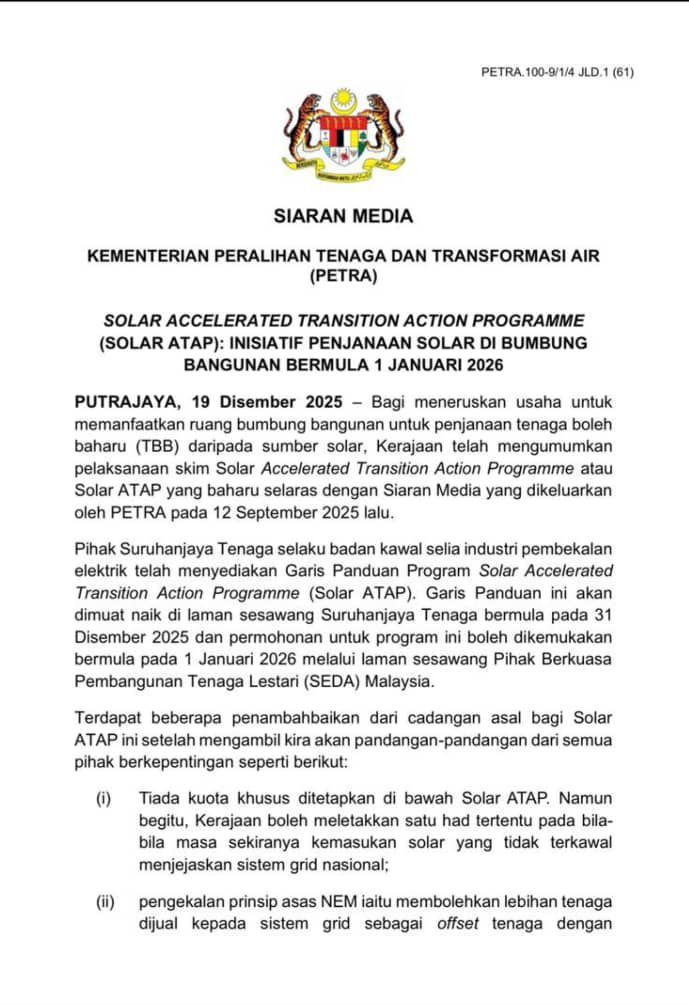
The Ministry of Energy Transition and Water Transformation (PETRA) has officially released an updated media statement today announcing the implementation of the Solar Accelerated Transition Action Programme (Solar ATAP). This programme introduces important improvements to Malaysia’s rooftop solar framework and will take effect from 1 January 2026.
Below is a clear and updated breakdown of what Solar ATAP is, what has changed, and how it impacts residential and non-domestic solar users in Malaysia.
What Is Solar ATAP?
Solar ATAP is a national initiative introduced by PETRA to encourage wider adoption of rooftop solar by optimising the use of building roof space for renewable energy generation. The programme is aligned with Malaysia’s long-term clean energy strategy and supports the transition towards a low-carbon electricity supply.
Solar ATAP builds upon existing solar mechanisms while introducing improvements that make rooftop solar more flexible, scalable, and attractive to users.
Implementation Timeline
According to PETRA’s announcement:
-
Solar ATAP Guidelines will be published by Suruhanjaya Tenaga (Energy Commission) starting 31 December 2025
-
Applications for Solar ATAP will open on 1 January 2026
-
Applications can be submitted via the SEDA Malaysia online portal
Key Updates Under the Solar ATAP Programme
1. No Fixed Quota for Solar ATAP
One of the most notable updates is that no specific quota is set under Solar ATAP.
This means:
-
Users do not need to rush to secure limited allocations
-
Rooftop solar systems can be planned and scaled more freely
However, PETRA stated that the Government may introduce capacity controls if uncontrolled solar deployment poses risks to national grid stability.
2. Net Energy Metering (NEM) Principle Maintained
Solar ATAP continues to apply the Net Energy Metering (NEM) principle, allowing excess electricity generated by solar systems to be exported to the national grid and used as an energy offset.
This makes Solar ATAP more attractive compared to pure self-consumption schemes, especially for users with surplus daytime generation.
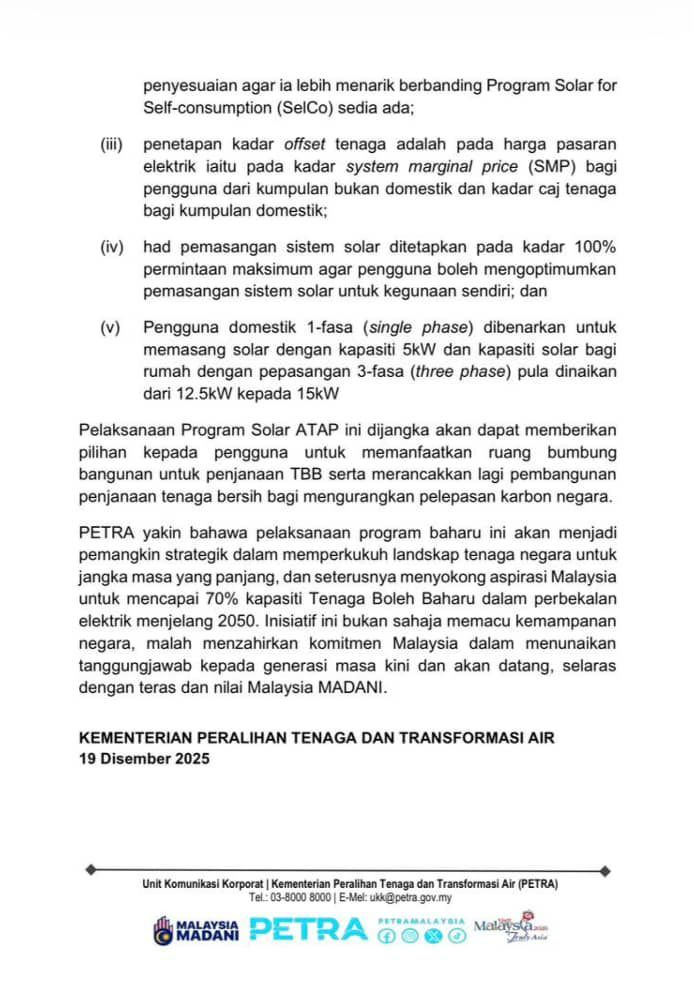
3. Energy Offset Rate Based on Market Pricing (SMP)
Under Solar ATAP, energy offset rates are structured as follows:
-
Non-Domestic Users (Commercial & Industrial):
-
Energy offset is based on the System Marginal Price (SMP) of the electricity market
-
-
Domestic Users (Residential):
-
Energy offset remains based on the applicable electricity tariff
-
This approach introduces a more market-driven mechanism for non-domestic solar users.
4. Solar Installation Capacity Increased to 100% of Maximum Demand
Solar ATAP allows users to install rooftop solar systems up to 100% of their maximum electricity demand.
This enables:
-
Better optimisation of rooftop space
-
Higher self-consumption rates
-
Improved return on investment for solar installations
5. Higher Capacity Limits for Residential Homes
PETRA also announced updated capacity limits for residential users:
| Residential Type | Electrical Phase | Maximum Solar Capacity |
|---|---|---|
| Domestic Users | Single-phase | Up to 5 kW |
| Domestic Users | Three-phase | Increased from 12.5 kW to 15 kW |
This change benefits larger homes and properties with higher electricity demand.
Why This Solar ATAP Update Matters
The Solar ATAP programme provides:
-
Greater flexibility for rooftop solar deployment
-
Reduced regulatory uncertainty due to the absence of quotas
-
Stronger incentives for both residential and non-domestic users
-
A clear pathway to scale renewable energy adoption nationwide
PETRA emphasised that Solar ATAP is expected to strengthen Malaysia’s energy landscape in the long term while supporting the national target of achieving 70% Renewable Energy capacity in electricity supply by 2050.
Final Thoughts
The release of Solar ATAP marks an important policy update for Malaysia’s solar industry. With no fixed quota, higher capacity limits, and market-based energy offsets, Solar ATAP creates a more progressive and scalable framework for rooftop solar adoption starting in 2026.
Homeowners and businesses considering solar installation should begin preparing early to take advantage of the new programme once applications open in January 2026.
This article is based on PETRA’s official media statement released on 19 December 2025. Further technical details will be available once the official Solar ATAP Guidelines are published by Suruhanjaya Tenaga.



