


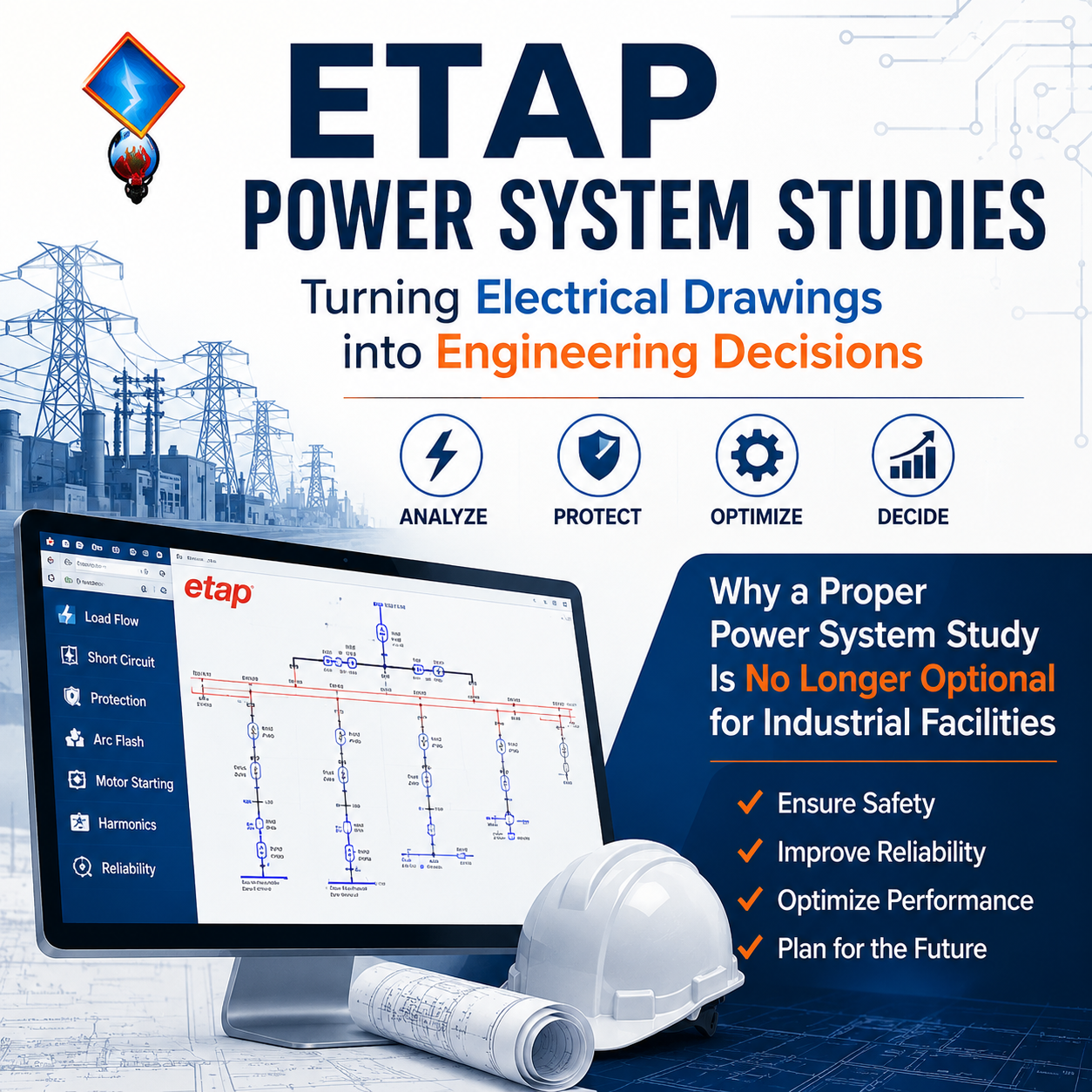
ETAP Power System Studies: Turning Electrical Drawings into Engineering Decisions
ETAP allows industrial, commercial and utility electrical systems to be modelled, tested and improved before changes are made on site.
A power system study is not paperwork. It is a decision tool to understand electrical safety, reliability, capacity, protection performance and future expansion risk.
Most industrial electrical systems grow over time. New transformers are added, motors are upgraded, generators are connected and production lines change. The system may continue to run, but that does not mean it is safe, selective, efficient or ready for future expansion.
ETAP provides a single engineering model where multiple studies can be performed using connected data. This is the main advantage: the same electrical model can support load flow, short-circuit, protection coordination, arc flash, motor starting, harmonic and reliability studies.
Electrical problems are connected. Fault current affects protection. Protection clearing time affects arc flash. Load flow affects transformer loading. Harmonics affect capacitor banks. ETAP helps engineers study these relationships in one model.
What Is an ETAP Power System Study?
An ETAP Power System Study is a structured engineering analysis of an electrical installation using a digital model of the site’s power system. The model is developed from single-line diagrams, transformer data, cable details, generator data, motor ratings, relay settings, switchgear ratings, load information and site-verified operating scenarios.
Once the model is built, the engineer can simulate how the system behaves under normal operation, fault condition, switching scenario, motor starting, harmonic distortion, arc flash event or future expansion.
Major ETAP Studies and Their Value
Load Flow Study
Evaluates how power flows through the electrical system during normal operation.
Value- Checks transformer and cable loading
- Identifies voltage drop and low voltage areas
- Supports power factor and loss reduction
- Validates readiness for new loads
Short-Circuit Study
Calculates fault current at different buses, panels, switchboards and feeders.
Value- Verifies breaker and switchgear fault ratings
- Identifies overstressed equipment
- Supports protection design
- Improves electrical safety and asset protection
Protection Coordination Study
Reviews relay, breaker and fuse operation to ensure the correct device trips first.
Value- Reduces nuisance tripping
- Improves selectivity between devices
- Protects critical loads
- Prevents minor faults becoming plant-wide outages
Arc Flash Hazard Assessment
Calculates incident energy, arc flash boundary and worker exposure risk.
Value- Supports NFPA 70E / IEEE 1584-based assessment
- Identifies high incident energy locations
- Supports labels and PPE review
- Allows before-and-after mitigation modelling
Motor Starting Study
Analyses motor starting current, acceleration time and voltage dip impact.
Value- Checks whether motors can start successfully
- Evaluates voltage dip impact on other loads
- Compares DOL, soft starter and VFD options
- Reduces commissioning and restart risk
Harmonic Analysis
Evaluates voltage and current distortion caused by VFDs, UPS, rectifiers and electronic loads.
Value- Identifies harmonic distortion risk
- Checks capacitor bank resonance
- Supports filter design
- Improves power quality and equipment reliability
Transient Stability Study
Studies how the system behaves after sudden disturbances such as faults, trips or large load changes.
Value- Checks generator stability
- Evaluates system recovery after disturbance
- Supports load shedding and emergency operation
- Improves resilience for critical facilities
Reliability & Contingency Analysis
Evaluates how the system responds when equipment fails or is taken out of service.
Value- Identifies single points of failure
- Checks N-1 operating capability
- Supports redundancy planning
- Improves shutdown and maintenance planning
Grounding & Earthing Study
Evaluates grounding performance during fault conditions, including touch and step voltage risk.
Value- Improves personnel safety
- Checks earth grid adequacy
- Supports substation and MV system safety
- Improves bonding and fault dissipation
Cable Ampacity & Voltage Drop
Checks whether cables are suitable for loading, installation condition, voltage drop and short-circuit duty.
Value- Prevents overheating and insulation stress
- Validates cable sizing
- Checks voltage drop impact
- Supports safe and cost-effective upgrades
Power Factor & Reactive Power Study
Reviews reactive power demand and compensation requirements.
Value- Reduces reactive power penalty risk
- Supports capacitor bank sizing
- Checks detuning requirement
- Improves system capacity and efficiency
Renewable & Distributed Generation Study
Evaluates solar PV, generators, batteries and other distributed energy resources.
Value- Checks reverse power flow
- Reviews protection impact
- Assesses fault level changes
- Supports safe energy transition planning
Why ETAP Is the Best Option for Serious Power System Studies
ETAP is strongest when the objective is not only to calculate values, but to understand how the electrical system behaves as one connected network. This is especially important for industrial sites where safety, uptime, production and compliance are all affected by the same electrical system.
Typical ETAP Study Workflow
Common Standards and References
Depending on project scope, ETAP studies may be aligned with recognised IEC, IEEE, ANSI and NFPA references, together with Malaysian regulations, Suruhanjaya Tenaga requirements, competent person requirements, owner standards and site HSE procedures.
What a Good ETAP Study Deliverable Should Include
Conclusion: ETAP Turns Electrical Assumptions into Tested Engineering Decisions
A power system study is a way to understand how the electrical system behaves before failure happens. It helps identify unsafe equipment, weak protection, high arc flash risk, poor power quality, voltage issues and future expansion limitations.
ETAP provides the strongest platform because it allows these issues to be studied as one connected system. It links load flow, short circuit, protection coordination, arc flash, motor starting, harmonics and other studies into a common engineering environment.
ETAP does not only show what the electrical system looks like. It helps prove what the system can safely do, where it is weak, and how it can be improved.